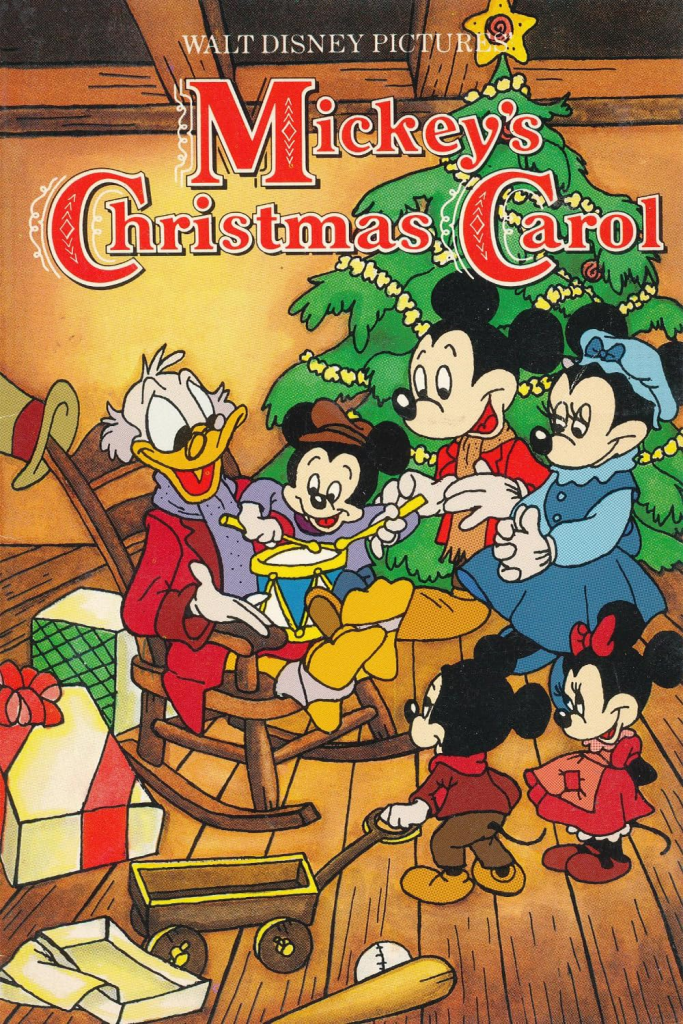
This week I got to watch Mickey’s Christmas Carol (1983) which was not a full feature-length movie, but turned out to be shorter than what I would call a short film. With a runtime of only 26 minutes, I quickly realized I was in for a bit of a doozy with this week’s review.
I only have good things to say about this one, it’s a one for one retelling of Charles Dickens’ “A Christmas Carol” featuring your beloved Disney characters as the cast. There are no name changes, and there is no deviation from the original story. Young Scrooge is portrayed as an evil miser, yet is heartwarming enough for a younger audience. Cratchit, played by Mickey Mouse, is exactly how you would expect. A good, hard working family man, who is stuck in a bad situation in life. Goofy makes a brief appearance as the ghost of Marley, Scrooge’s deceased partner. The three Spirits of Christmas are also played by classic Disney favorites, the Ghost of Christmas Past played by is Jiminy Cricket (Pinnochio), the Ghost of Christmas Present is played by Willie the Giant (Mickey and the Beanstalk), and the Ghost of Christmas Future is played by Pegleg Pete (Mickey’s former adversary). Donald Duck is even featured in this, albeit as a very minor character, Cousin Fred.
There is only one song in this short movie, during the title and credits sequence at the beginning. Perhaps featuring another song in Disney fashion would have been more fitting, but I’m not sure if the characters bursting into song would have worked for this.
The movie is perfectly catered to the younger audiences, it has no down time, is short, concise, and hits all the major points of the original story. Cratchit wants to spend time with his family on Christmas, and Scrooge is visibly annoyed by this, and says only if he comes in early the following day. Of course Cratchit is extremely happy by this answer, and offers to come in even earlier the next day. That evening, Scrooge is met by the three Ghosts of Christmas.
After a night with the Ghosts of Christmas, you can expect the outcome. Scrooge has a turn of heart, and donates money to the poor, gives out turkeys, accepts Cousin Fred’s invite to Christmas dinner, and gives a raise to Cratchit. A nice, feel good ending, much like the work it’s based on.
All in all, I would say this movie is cute, a classic Disney short, and a solid homage to Charles Dickens’ work. I never saw this as a kid, it was released years before I was born, and I was already familiar with the story, so I never sought it out, I’ve seen this story told time and time again over the years in various other shows and movies. However, watching this as an adult, I can see the appeal of it especially if you are a child yourself, or have children. A nice, feel good movie that tells a story we are all familiar with, and leaves you feeling hopeful about the world around you in a sense.
3.5 mallards/5
-Seann
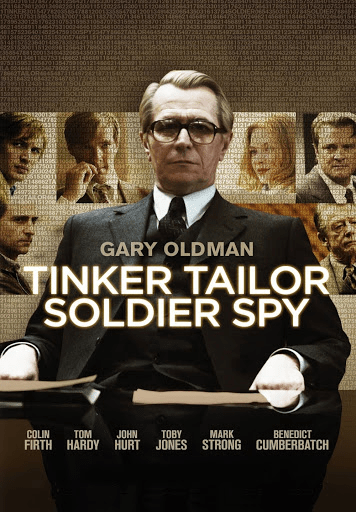
Tinker Tailor Soldier Spy (2011) is the first critically-acclaimed film we’ve reviewed on this blog. Sometimes the randomizer throws us a bone, it appears. To contrast this film with the previous three I’ve reviewed would be an exercise in futility, as it’s so vastly different in quality, aims, purpose, budget, and cast. Unlike Holmes and Watson, which was universally detested, this film is universally enjoyed, or at the very low end of the spectrum, tolerated. That’s not to say that this film is not without issue (we’ll get into the two big issues with it soon), but it is generally considered a work of art, and a fine addition to the canon.
As for the backstory of the film – this is one of perhaps the film’s weakest points, ironically. This film is an adaptation of a novel, Tinker Tailor Soldier Spy, written by John le Carre, published in 1974. What’s the weakness in this? Well this is book one in a three-part series, but it exists in the same universe as other novels by Le Carre. While it’s not always a criticism of a literary film that it’s based on one book in a series (the Harry Potter films, individually, did quite well), the trouble begins to arise when the density of the novel and opacity of plot exceed a certain threshold. Put simply: this film is extremely difficult to understand.
Before I go further into the things about this film that make it challenging, I’d like to extol its virtues – and there are many. Firstly, this is a cast of extremely well-respected actors. The lead, Gary Oldman (who is also in the same Harry Potter films mentioned above), is an absolute chameleon, and one of the finest actors of his generation. The supporting cast boasts such names as Benedict Cumberbatch, Colin Firth, and Tom Hardy. This is one of those films where any time a new character appears on screen, you think “oh, I know them from ——”. The performances are, down to a man, impeccable. The characters are fiery, and though some of them are only on-screen briefly, or have few speaking roles, develop a personality of their own. Somehow we manage to get an idea of what the character is, the type of person they are, within moments of meeting them.
Secondly, the set design, locations, and wardrobes are immersive. As mentioned previously, the density of the plot of this film can obfuscate the action and events, but the environment does a great job of subtly indicating what’s going on. This is a non-linear story, but we get an opening scene in which Gary Oldman’s character, Smiley, gets new eyeglasses. Attentive viewers will realize that any scenes in which he has the new glasses is happening at the time we see it, and any event in which he has the old glasses is a flashback. There’s no other indication that we have traversed time, so if the viewer missed the detail the first time, they have no shot at understanding what’s going on. That means that this film lends itself to at least one, more likely two re-watches, which most viewers (I would surmise) are more than happy to do.This isn’t the only example of the mise-en-scene contributing to our understanding of the plot – this film is truly an advanced study in the art of subtle storytelling.
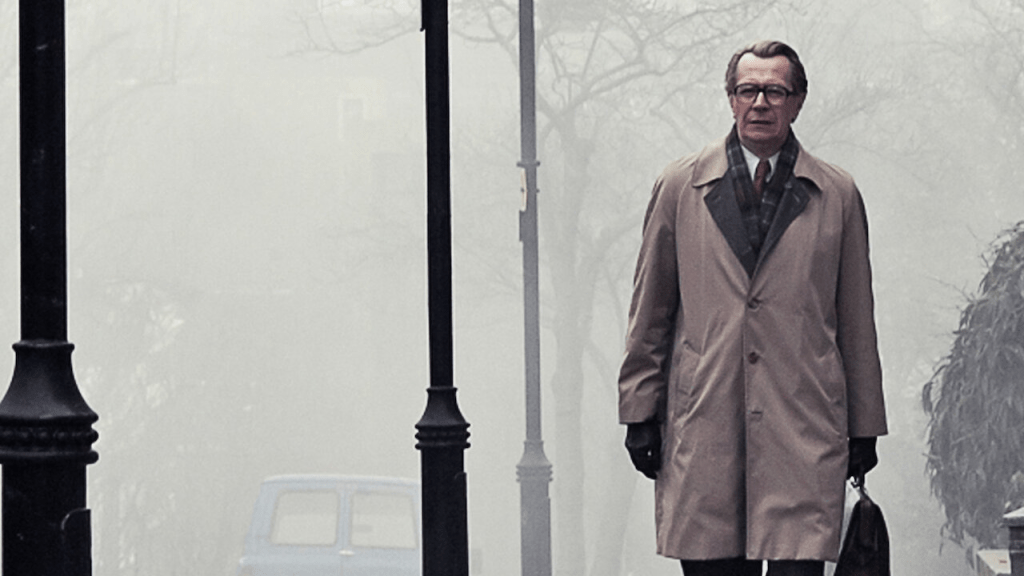
Thirdly, the camera movement in this film is masterfully artistic without being obvious. Most shots in this movie are pretty tight on the actors’ faces, or the items in focus. This is, as the title implies, a movie about spies and saboteurs during the immediate post-WWII era. Nobody can be trusted without a slight amount of trepidation, and the tight camera focus serves to highlight the isolated nature of the psyche of the characters. There’s no one you can trust but yourself, and even that gets called into question in this film. The lighting is almost a character of its own – it is just drab, no matter where in the world we are. When we’re in Hungary, it’s a drab, overcast sky. When we’re in England, it’s the same. The headquarters of the “Circus” (the British intelligence agency) are sartorial, but melancholy. Smiley’s study room while he’s on the case is cold, despite its obvious lived-in-ness. This is a film that really does a great job of highlighting that there is nowhere comfortable and safe, and there are no characters that are beyond suspicion or anxiety.
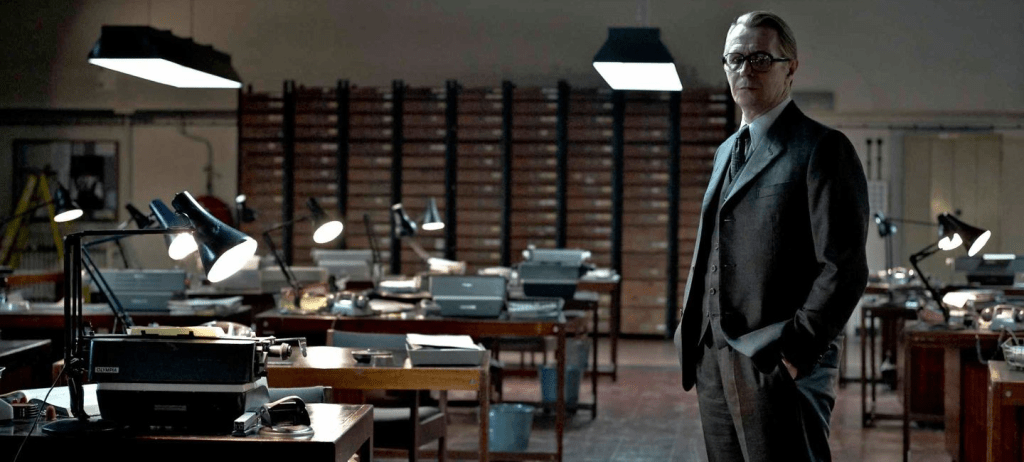
The last great thing this film does (that I’ll touch on – there are many positive aspects of note) is pace itself. There are a lot of characters, a lot of events, and a lot of action in this film, despite its relatively short runtime of just over two hours. This could easily have become a sprawling, multi-act film of around four hours, but each scene is jam-packed with detail that uncovers more and more of the story. Even the seemingly innocuous atmospheric details are often important to the overall plot – another reason why this film lends itself to multiple rewatches. There are no scenes that are superfluous, either. There’s significant progress made towards unraveling the mystery in each scene, often progress made towards multiple plot points at once, while still maintaining character depth and world-building. These various aspects and goals are all juggled masterfully.
Despite all this, this is not a perfect film. There are interactions between characters that, even after multiple re-watches, are difficult to deduce the reason for. While we do have the advantage of stopping the movie and rewinding at will, that’s not something that I would really recommend while watching. For a first watch, just let it play, and know that you will be very confused. For watchers who might not have the disposable time to watch this movie multiple times, this could be a real drawback. The other critique I have of this film is that it’s difficult to understand what the characters are saying sometimes. This might be just because I’m American, but I find some of their accents to be difficult to understand. I watch this with closed captions, despite the vast bulk of the dialogue being in English. I’m also still not sure I understand the big reveal at the end, despite watching multiple times. The final three scenes seem a bit rushed, in contradiction to my praise for this film in the previous paragraph.
Tinker Tailor Soldier Spy (2011) has a score of 7.0/10 on IMDB, a score of 3.7/5 on Letterboxd, and an 84% tomatometer score on Rotten Tomatoes. My feelings fall closer to the Rotten Tomatoes score. I think this is an exceptional film, not amongst the greatest of all time, but one that I would happily watch again. This isn’t a film to watch with the guys or girls while you sit around and drink beer – I think this is best watched on one’s own, maybe with pen and paper at the ready. A perfect film has to be watchable in all contexts, and this one just isn’t something to watch after a long day at work, for a date night, etc.
4 mallards/5
-Maxwell
 Mallards Movies
Leave a comment