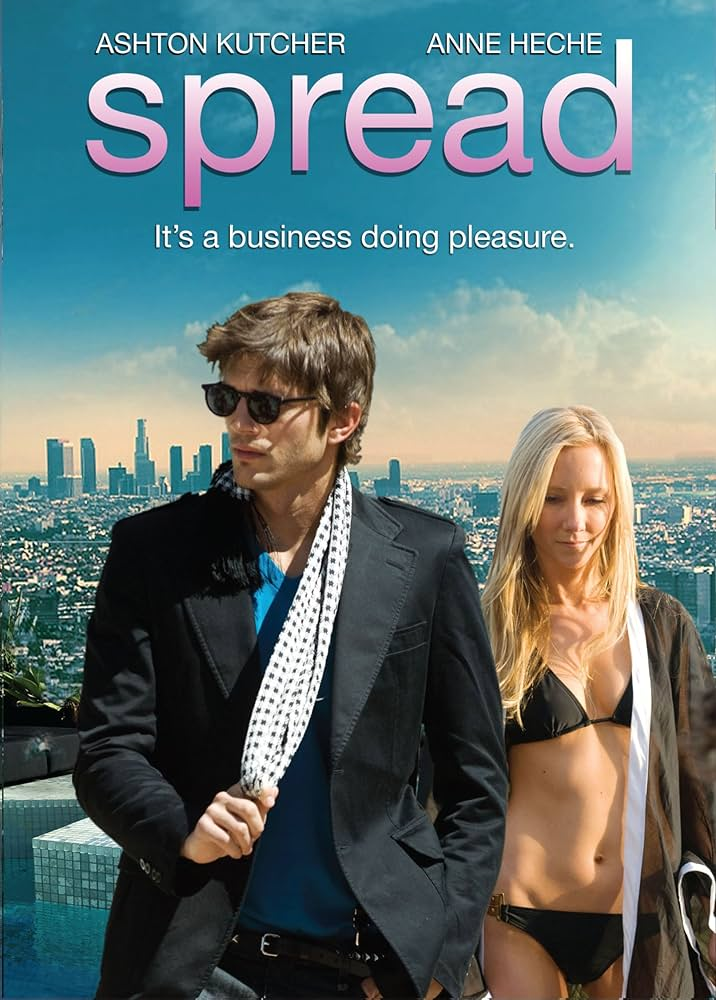
Spread (2009) is a film that prior to this month’s draft of films, I was entirely unfamiliar with (and for good reason.) This movie had me rolling my eyes not 30 seconds in, and honestly, after last week’s film Land of Bad, I did not think I would be subjected to a worse watch. Boy, was I wrong. The opening lines of dialogue in Spread comes from Ashton Kutcher’s voice over narration, “My whole life it was obvious I was gonna end up in this city.” (Referring to LA.) “I don’t want to be arrogant here, but I’m an incredibly attractive man.” he continues. Queue me and my girlfriend groaning while watching. This immediately set the tone of the movie for us. And, spoiler alert, but even with the ending of him not getting his way in life and essentially going back to square zero to have to rebuild what little he did have, I still thought this one was a movie I’d like to forget sooner than later.
I’m going to take a moment to talk about the costuming in Spread, because even though it was made in 2009, and I am of the age range of millennials who had Myspace fashion growing up, this movie takes it to the extreme. Nikki (Ashton Kutcher) is wearing jeans with those skinny black leather suspenders in almost every scene, often accompanied by t-shirts, or the occasional flannel. Not a single outfit befitting of suspenders. He is also living in Los Angeles in what appears to be constant beautiful, sunny weather, and is often seen wearing a black and white checkered scarf (as seen in the movie poster above) which is beyond absurd, although it does add to the overall douchiness of his character. At least it worked from that angle.
About fifteen-twenty minutes into the movie, I was asking myself if this was either a) a movie written by two men (Jason Hall and Paul Kolsby) who had never had an interaction with a woman who was a willing participant in the interaction i.e. a teacher, or a waitress, or b) if this was a meta movie about how some men view themselves. Sadly, by the end, I believe it to be more of the former than the latter. Outside of the ending, which leaves the viewer half satisfied after enduring a film with such a dislikable main character, this movie does anything but leave you feeling satisfied.
Nikki is a broke and homeless “model” who finds women around LA to mooch off of. The entire opening sequence is him discussing how he locks down women at various parties around the city and crashes at their places. As a man watching this film, I felt nothing but the ick every interaction he had with a woman for the entire duration of this film. At the first party we see him go to, he meets Samantha (Anne Heche) and follows her around acting like a lost dog who has just found his forever home. After she tells him off a few times, he follows her outside, and assaults her with a kiss. Like most bad Hollywood romances, this causes the woman (Samantha) to immediately want him more. She brings him home to her multi-million dollar home and lets him crash there. All the while he’s keeping up the curtain that he’s actually worth something to impress her. This one night stand turns into a weird romance, at least from her perspective, so Nikki gets his way.
She ends up leaving for a work trip, and allows him to stay at the house, so what does he do? He throws a house party and fucks other women while she’s out of town. She ends up returning home from the trip a day early and walks in on him watching football and receiving a blowjob from a random girl in a 49ers helmet (disgusting, as a loyal partner, and a Seahawks fan myself, absolutely disgusting.)
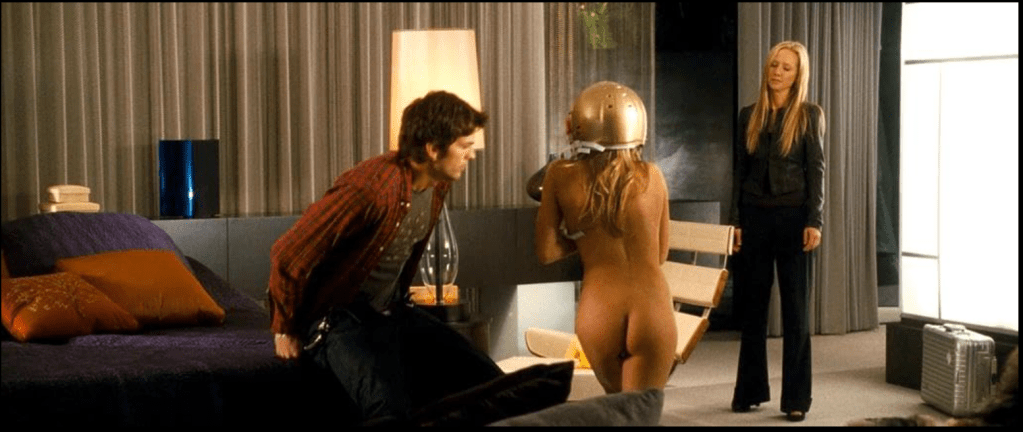
This of course causes a big argument/fight as Samantha is practically chasing him out of the house. Queue a bigger eye roll from me than the opening scene got; Samantha says “Aren’t we in love?” during this argument. Abhorrent writing, the women in this film are written solely for the purpose of being man-serving sex objects. Somehow they end up staying together and there is a montage of them fucking all around the house.
So, how does Nikki handle this? He finds a waitress who wants nothing to do with him, runs out on the bill, and she chases him down, back to Samantha’s while Samantha is at work yet again. Of course, Nikki and the waitress, Heather (Margarita Levieva) have steamy sex. Because that’s what this entire movie is about, women being servants to Nikki. Nikki goes crazy for this waitress, until he finds out that she herself is a grifter, and is mooching off of rich men around LA herself. This leads to one of the weirdest scenes of the entire movie, where Nikki freaks out and kicks her out of not his house, yells at her, and calls her “a fucking whore.” It’s clearly his hypocritical nature and projection, but the acting is so poorly done that the end result is an obscene scene.
The other extremely weird and out of place scene in this movie is when Nikki meets two of his friends at a stripclub and one of them is throwing money on stage at the stripper and repeatedly asking her to “play with her box” for him. For some reason, Nikki gets extremely heated during this exchange, and punches the other guy in the face, getting himself kicked out of the stripclub and abandoned by his friends.
Back to the Samantha plot line, she has surgery to tighten her vagina, and now that she is recovering and can’t have sex for five days, she finally wisens up and kicks Nikki out. So what does he do? He moves in with Heather at her small house, where she says she’ll let him crash on the couch. Of course, this isn’t good enough for Nikki, so he just enters her room and bed, completely violates her, and she starts to fall in love with him, because Hollywood, right?
It was during scenes like this that I no longer believed this was option b, but was clearly option a. After googling who the writers were and seeing that one of them was a top producer on the TV show Bridezillas, it cemented my belief that this is a movie written by two men who had never had a conversation with a woman who was a willing participant.
As Nikki seemingly falls more and more in love with Heather, he learns that she was engaged to a man in New York, but came to LA to chase her dreams. One day she finally leaves back to New York to “sort this out.” leaving Nikki alone in her house. He does the whole “Hollywood grand gesture” of getting a ring and getting on a plane to find her and propose. Upon getting to New York, he learns that she already went through with the marriage, and she refers to him as ‘The grocery delivery boy’ in front of her new husband. Nikki returns to LA defeated, and ends up becoming a grocery delivery boy and living on his friend’s couch.
A fitting end for a terrible character, but the ride to get there was so horrendously awful that it still leaves a bad taste in your mouth.
0.5 mallards/5
-Seann

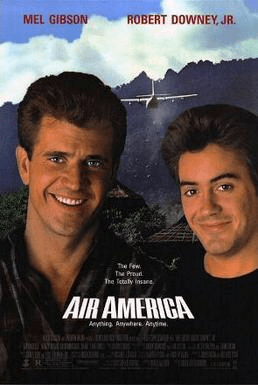
Air America (1990) is a film that I had never heard of before it was randomly selected this week, and it’s not hard to tell why. Starring co-leads Robert Downey Jr. (before his story took a turn for the worse) and Mel Gibson (likewise, ironically) and a modest budget of around 30 million, this film is the exact type of star vehicle that Hollywood was churning out in the late-80’s and early 90’s. Not only were two handsome big-name actors on the poster, but it was based on a true story that was perhaps still fresh in people’s minds. As with any based-on-real-events movie in Hollywood, the action is dramatized, characters are flattened, the audience gets a less nuanced look at the events, etc. All those things aside, this film honestly did surprise me.
RDJ’s hammed up Tony Stark, through which he’s re-ignited his career in a huge way, can easily lead modern audiences to forget that he actually does have (or had) some exceptional acting chops. His character in this film isn’t the most consistent, but that’s a small complaint about the script. The character is portrayed expertly by Mr. Downey and in fact becomes more magnetic than the script calls for. While the action sequences drag on far too long (one scene features a plane crash that takes seven minutes to conclude from the time the plane hits the ground to when it stops moving), they all feature Downey, who has endeared himself enough to the audience, or at least this audience, that the tension is held.
The same cannot be said for Mr. Gibson, unfortunately. His character has few interesting moments in the film, and the moment of catharsis at the end, in which his character undergoes a moment of conscience, doesn’t feel justified. His character is not quite as developed as the character of RDJ, perhaps due to appearing fewer times on screen, or simply through having a thinner spectrum of acting abilities. Gibson’s character is consistent throughout, which is good in some ways and bad in others. He’s established as the foil to Downey’s unseriousness, but that is challenged when Gibson has moments of unseriousness as well. When one plays the straight man and the other a jester, and in the following scene their roles reverse, it makes it difficult to get an idea of their dynamic. While it’s good to have characters that are not static, meaning that they have personalities, they still need to be somewhat consistent to make a cohesive unit.
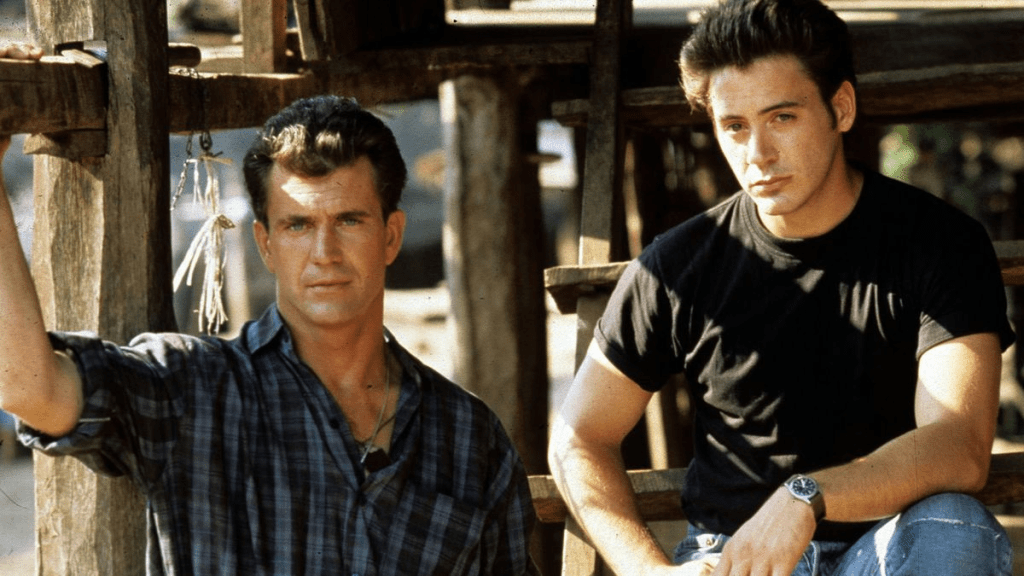
To take this further, there is an entire cast of comedic-relief characters. There’s a US senator who complains openly about ‘youth culture’ and ‘too much rock’n’roll’. There’s a stooge who is the manager of the pilots, who is naive and knows nothing of war who hatches a plan to drop jumbo-sized condoms from the warplanes into enemy lines (to intimidate their enemies, I guess). There’s a hardened war veteran who is working with the Laotian general to smuggle drugs. There’s a pilot who has frequent moments of hysteria (and is also afraid of heights). This film seems to take place in a world of caricatures that are incapable of taking anything seriously, even when lives are on the line and there’s a literal WAR going on. I don’t think there’s any true moments of comedic relief in this film, but on the contrary, there are three or four discernible moments of SERIOUS relief. I understand this is a comedy, but the best comedy films still have a serious plot at their core. What could be more serious than war?
That isn’t to say that the film isn’t funny. There are some very humorous moments in which these characters interact. The scene in which the audience is introduced to the RDJ character is a great example of unexpected humor. As the film goes on and the characters fail to develop past the archetypes we see when they’re introduced, some of the charm wears off. By the end of the movie, I was frequently checking the clock to see how much longer until it ended. Fret not – it ends just in time to avoid any major errors or accusations of an inflated runtime.
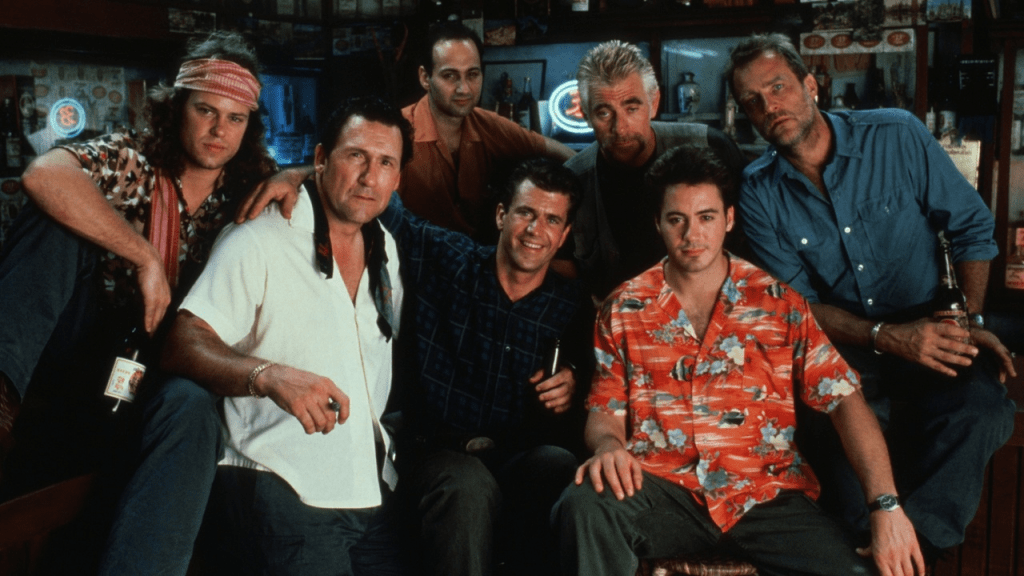
The action scenes, unsurprisingly in a movie about pilots, largely involve planes. There’s also explosions. So many explosions. There’s a scene in fact (the crash mentioned above) in which a plane’s wing hits a stack of barrels of (presumably) oil and KABOOM a big explosion happens. That’s the extent of action provided. There’s a few moments of gunfighting, no close quarters combat between anyone, no swordplay, no car chase sequence. There’s not even a plane chase or a dogfight. The only action is planes crashing and then planes exploding.
Despite these downsides, this film is actually good-ish. The plot is largely character-driven, which in a film that I just criticized for having flat characters sounds like a death sentence, but it somehow works here. I think the RDJ character is just round enough to propel everything forward. The plot is also convoluted, despite not being particularly hard to understand. We as the audience know what’s going on well before the characters do, but there’s little suspense as to when the characters will find out. There’s no plot twist or any sort of surprise for the viewer – we see events happen in a chronological way, and we just sort of watch and wait for the characters to find out the events.
Additionally, the soundtrack is great. It’s a mixture of classic rock songs (though it is quite corny when the two stars are running through the jungle and the CCR song ‘Run Through The Jungle’ plays) and high-energy rhythms. The film looks adequate. I’m not sure if it was filmed in Laos (where the action of the film takes place) or not, but the massive jungle passes well enough. The planes look like planes. The characters look like pilots. There’s nothing that pulls the viewer out of the film, and there’s nothing that immediately jumps out as spectacular either. Those explosions I mentioned earlier? Just regular explosions – no Michael Bay dramatics here.
Air America (1990) has a 5.8/10 on IMDB, a 35% popcornmeter on Rotten Tomatoes, and a 2.9/5 on Letterboxd. I’m inclined to agree with the IMDB and Letterboxd scores. I think this is a very passable film, featuring two great leading men at the heights (very oddly) of their careers, no pun intended. Would I suggest it to a friend who was looking for a way to spend 2 hours? No, I would not. Would I balk at someone who said it was their favorite film? Likely. Would I leave the room or turn it off if I walked in someone’s house and it was playing? No, I don’t think I would. Overall, it’s a rather forgettable middle of the road action/comedy movie of the early 90’s, and it doesn’t really elicit any strong feelings in either direction. In a few years I’ll likely forget that I ever saw it until it’s put before me again.
3 mallards/5
-Maxwell
 Mallards Movies
Leave a comment