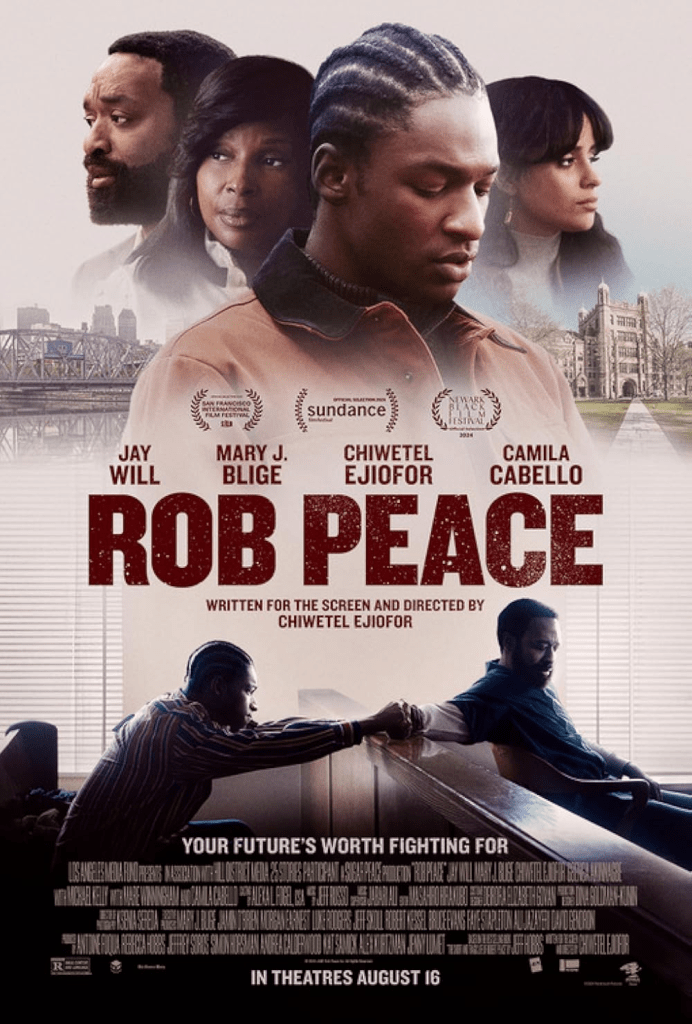
My movie for this week is one I had never heard of before, Rob Peace (2024). I had no expectations when sitting down to watch it, all I knew was the one sentence blurb from IMDB explaining it as a drama about a son and a father who is convicted of a crime he may or may not have committed, and that it is based on a New York Times best selling book, which is itself based on a true story. This movie is heartwarming, depressing, raw and real all at the same time. I was honestly surprised by how much I liked it. There will be spoilers ahead.
The cinematography is the first thing I want to talk about, the lighting, framing, and general mise en scene of this movie was extremely well done. Every scene felt like you were there, it wasn’t flashy, there are almost no special effects in this one, and yet I was kind of in awe watching it and seeing the scenes play out in front of me. The colors of the background, the settings etc all just worked to really put you into Rob’s world.
The movie starts off with the main character Rob “DeShaun” Peace (Jay Will) as a kid spending time with his dad, Skeet Douglas (Chiwetel Ejiofor) who is estranged from his mother, Jackie Peace (Mary J. Blige). In the opening scenes, Shaun is only ten years old, and his dad is a small-time drug dealer, already giving you insight into the world of the East Orange ghetto of New Jersey that they reside in. Skeet is seemingly a good man, and wants to give his son a better life than he’s had for himself.
The very next day, a shooting takes place in Skeet’s building, and two women are murdered. The police have Skeet as their prime suspect despite inconsistent evidence, and he gets life in jail. This sets Shaun off on a sort of lifelong tirade to do what he can to free his dad. But Shaun’s mother also wants him to go to private school to have opportunities that she and his dad never got. And Shaun excels at the private school, to the point that upon graduation he gets into Yale with his tuition covered. But East Orange has a grip on Shaun in many ways.
The characterization and acting of this movie really hold you, the viewer, to the screen. I’ve seen many poorly done character dramas that try to be deep and meaningful and fall flat over the years, a good example being Arbitrage (or as Maxwell and I call it “Arbit-Rage”). Rob Peace portrays its characters and the problems they face in an impactful way. The circumstances of the world into which Shaun is born and grows up, the opportunities he clings to, the disenfranchisement as he’s a black kid from the ghetto going to Yale with a convict for a father (regardless of if his dad is or isn’t innocent.) Shaun also clings to the good in the world. I grew up with a small family, and was taught from a young age that friends are the family you get to choose. Skeet teaches Shaun that “You look out for people and they look out for you. I don’t believe you can ever be facing the wrong direction if you’re standing by your people. Ever.” and Shaun holds that close to his heart throughout the entire movie. It’s a similar sentiment to how I’ve lived my life, and I’ve had some great people in it because of this mentality, so this core element really hit home for me.
As Shaun progresses through young adulthood, and Yale, his father stays in prison, despite his attempts to overturn the conviction. Eventually, Skeet develops a brain tumor and is given six months to live. Shaun is studying medicine and cancer research at Yale. Life can be cruel like that sometimes, in a sadistic and ironic way. One of the last interactions Shaun has with his father is asking him for “the truth” of what happened that night with the two women who were murdered. An emotionally intense scene as his father is hospitalized with worsening cancer. It’s only after Skeet dies that the truth comes out that Skeet didn’t have a gun, and that the cops planted one on the crime scene to convict a poor black man in the ghetto and “bring justice” to the women’s families.

The hold that East Orange has on Shaun throughout the entire movie ultimately becomes his downfall. He’s started a real estate business with his friends, not for profit, but for the betterment of his community. Part of this is selling marijuana on the down low to get funds quickly. He’s a scientific genius and crossbreeds strains and processes them to make them more potent than the garbage the gangs in the area sell. This is something he did at Yale to try and get money for his dad’s cancer treatment, but he didn’t earn enough in time before his dad’s cancer worsened to the point of fatality.
The end of the movie is Shaun being shot and killed by gangbangers for stepping into their territory, which I was not expecting, since the entire movie is narrated by Shaun, and sounds like his application letter for a PhD program, which was another goal of his. I thought that the style of him narrating the movie was really interesting, especially since it was sort of a beyond-the-grave situation in the end.

This movie had me in tears at various points, in awe, and just sitting in the dark room as the credits played saying “wow” quietly. The performances were real and very well done, every character and actor did a wonderful job, even the minor characters like Father Leahy (Michael Kelly) at the private school when Shaun attended, and later when he worked there for a short while, had a massive presence on the screen. This is a movie that I would definitely recommend you watch.
– 4 mallards/5

-Seann
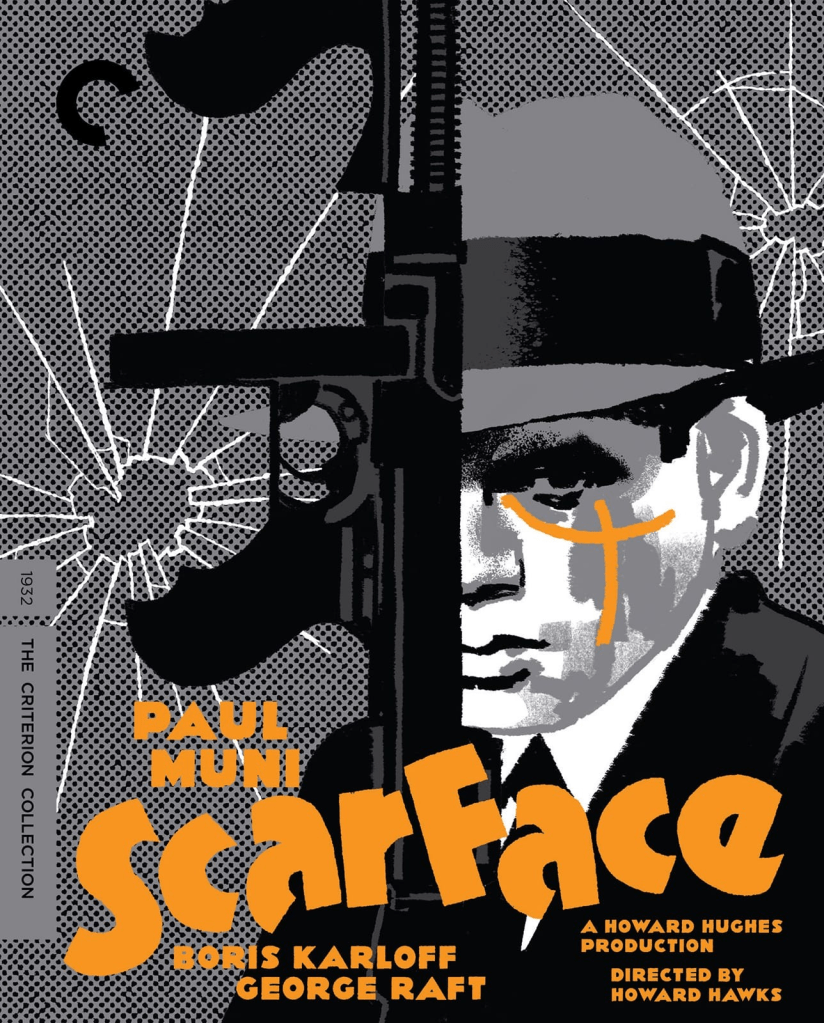
Scarface (1932) is the oldest film we’ve reviewed (yet) on the blog, which, due to my own personal predilections, means it’s gotta be one of the best. Call it bias if you will, but I like old things. Anyway, this is the first film selected that is pre-code, which is something I’ll get into in a moment, but it has a drastic impact on the film overall. This is before any sort of filmic conventions were established, like the 180 degree rule, the standard 90 minute run time, and others. This film is only 69 nice minutes, but they are a pretty good 69 minutes with no fluff.
For about five years between when films featured speech (“talkies”) and when the Motion Picture Production Code (MPPC), so roughly 1929-1934, films were considered ‘pre-code’. These are some of the more interesting films in American film history because they often feature things on screen that weren’t seen again until social mores relaxed in the 1960’s (which led to the American Film Renaissance, or AFR – another high point, and perhaps the last, in American film history). They often featured ‘taboo’ themes, such as female sexual freedom, violence, unpunished criminals, alcoholism, and visceral killing. It was, in all honesty, a pretty wild time, but that freedom allowed filmmakers to make some really interesting and artistic films, of which this one is a good example.
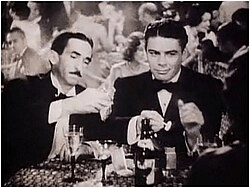
History lesson over (or more likely to be continued in a future review). Let’s talk about Scarface (1932). This movie has one of the greatest opening scenes I’ve ever seen. It features an exceptionally long dolly shot, introduces the major players in the film, has incredible set design, use of shadow, and great sound. It’s really quite the scene – I’d honestly recommend it as a study in camera movement and production. The second scene is also a long dolly shot, but in the inside of a news room, and has a few issues. The film starts out on a massive high note, takes a step down, and then stays pretty consistent quality-wise throughout. If the quality or filmic artistry stayed consistently at the level of the first shot, this would undoubtedly be an all-timer.
Some of the pre-code things featured in this movie that wouldn’t fly after the Hays Code was enacted include: a woman being slapped, prostitution, exorbitant drinking, visual depictions of executions, and a few other more minor things. Also interesting are the title cards at the start of the film. They are effectively a call to arms of the US Government and law enforcement. The title cards claim that the events depicted are true and that they happen every day on American streets, and asks what the government is going to do about it. It goes a step further and asks the viewer what THEY are going to do about it. An instance of breaking the fourth wall? In the year of our Lord 1932? Rebellious indeed.
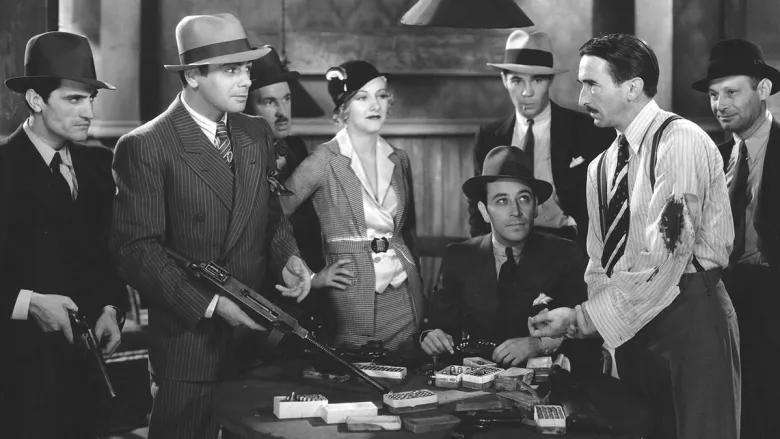
The plot of the film is pretty straightforward. Scarface (played by the great Paul Muni) is a low-level grunt in an Italian street gang. He performs a successful hit for which he’s not punished (pre-code, again), and has illusions of grandeur. He hatches a plan to become a big boss in the crime scene of the city, and his plans are further cemented after a fiery confrontation with his boss, Lovo, regarding what their next move should be. Eventually he seduces Lovo’s girl (pre-code), and Lovo sets him up to be killed. Scarface uncovers the plot, executes Lovo, and thus Scarface becomes the big boss. Though he does meet his end by the final moments of the film, the overall structure is very engrossing. The 69 minute runtime, again, makes this a pretty exhilarating crime thriller. The condensed time means there’s few opportunities for obtrusive things like character development, backstory, or exposition. I jest, of course, but it doesn’t really feel like there’s anything lacking, despite the shortness.
So, what’s wrong with this film then? Spoiler: I’m not giving it a 5, so what’s missing? Well, while the film is pretty good, and very good in parts, there’s a few things holding it back. Some of the scenes are not particularly well-shot, the dialogue is off-timed with how the character’s mouths move, the editing is shoddy through a decent amount of the film, and the acting, other than Mr. Muni, is awful. Some of these can be written off to the time at which the film was made and the technology that was available to them at the time, but some of the things seem to be just laziness. With a couple more takes (which I understand would have been very expensive at the time it was made, but I think producer HOWARD HUGHES of The Aviator fame could afford it) I think this film could have been improved significantly. With a little more time spent on editing and sound, a likewise effect could have been achieved. Some of the basics of filmmaking are a bit rough, which to an extent is expected due to the time at which it was made, but this is an entire decade after the masterpiece that is Nosferatu (1922) came out. I’m not comparing this to Nosferatu (1922) for a myriad of reasons, but my point is that the ability to eliminate these errors was available at the time, but for some reason not utilized.
Finally, as I’m sure you are aware, this film was “remade” (with a completely different plot) in 1983, as the famous Scarface (1983). This movie stars, of course, friend of the channel Al Pacino as Tony Montana as the eponymous Scarface, and is largely considered one of the finest movies of the 1980’s, and even beyond. While the connection between them is tenuous at best, it’s worth noting that the 1983 version does pay many homages to the version discussed here. I think if you’re a fan of the 1983 film, as you rightly should be, then it would be worth your while to watch this film as well. The blueprint for the films is very similar, and the legacy of the 1932 film lives on in the re-incarnation and spiritual successor.
Scarface (1932) has a score of 7.7 out of 10 on IMDB, an incredible Rotten Tomatoes tomatometer score of 98% (!), and a Letterboxd score of 3.8 out of 5. I’m bouncing back and forth between a 3.5 and a 4 on this one, which seems about in line with the general consensus. There are a lot of great aspects of this movie, which would push it up into the 4 range, but there are some things holding it back. Some of the rougher aspects are kind of hard to watch in the modern day, especially after the hyper-glossy popular movies such as the MCU movies. The errors don’t particularly endear this film in the way that some other films of this time do – they mostly just come off as sloppy. That being said (or written), when compared to other films in this genre and of this era, this is undoubtedly the finest. If I could give this a 3.75, I would, but I cannot. Luckily for Muni and friends, I’m feeling slightly generous today.
-4 mallards/5
-Maxwell
 Mallards Movies
Leave a comment