
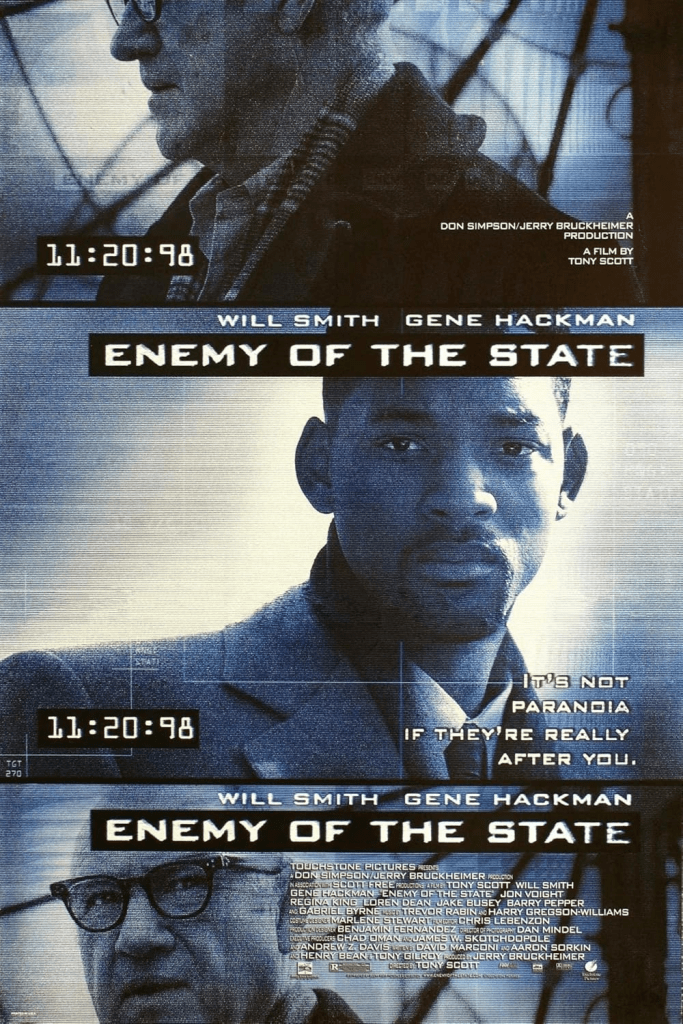
For my first film of June, I was able to draft a film that I was actually excited about for once. I had seen this as a teen, I know for sure that this was one that my dad owned on DVD or Blu Ray back in the day. Enemy of the State (1997) is a kind of film that was right up my dad’s alley. And now having rewatched this film, this is one that is up my alley as well. I was glued to my television from the start. I have mentioned in previous reviews how I am not a fan of films that feel drawn out and take forever to bring the plot to fruition, (here’s looking at you, Dune Part One (2021) and Dune Part 2 (2024) and Dune Part 3 (2026)). Enemy of the State starts hot and stays hot up until the end, in all the right ways.
I am also impressed that this film was in production in early 1998, three or so years pre-9/11, and pre-The Patriot Act. Watching this in 2026, twenty-eight years later, gave me a lot of weird feelings about the surveillance state that America has become. The fact that elected “officials” have this kind of power is honestly terrifying. Clearly this film shows an abuse of power over a situation they think they can control, but when the “control” is over something they know nothing about, and the target subsequently also knows nothing about, it’s purely just exercising a power that no one person should be able to wield. Which I know is the whole point of the film, but still felt necessary to add here.
This film revolves around Robert Dean (Will Smith) who is a lawyer in the DC area (despite half of this movie being filmed in Los Angeles) who finds himself involved with the assassination of a Representative, Phillip Hammersley (Jason Robards; an unaccredited role). The entire plot of this film revolves around conspiracy theory level espionage and the extent to which people will go to get their way. It’s honestly an intriguing and action packed film that I would recommend to anyone looking for something fun and thought provoking to watch.
I am a lover of most modern cinema, I just saw Back Rooms (2026) in theaters yesterday, and I loved every second of it. Back Rooms is the kind of film that leaves you pondering what you just witnessed a full twenty-four hours later. And I think the same holds true for Enemy of the State. While these two films are in entirely different leagues of what they are at their core, they both serve their purpose extremely well.
The cinematography of Enemy of the State was really interesting, there is a scene where Robert Dean is arguing with his wife, Carla Dean (Regina King) while the government is trying to discredit him, so he is unable to talk about or release the info that they think he has against them. This scene is full of quick cut shots, weird angles, and back and forth dialogue. I felt uneasy as hell during this altercation between the characters, which is the intent. The framing and jump cuts, the dialogue, and the acting all come together to make the viewer feel uneasy and awful, which is the intent. Well done, in my opinion.
The pacing of this film is superb. The film starts and doesn’t stop until the credits roll. Every character serves their purpose in the best possible way, events unfold, and how quickly they unfold in a 127 runtime is rather impressive. The “minor” side characters to the story even feel important, here’s to looking at you, Seth Green, who has an uncredited role in this film.
Robert Dean, as a lawyer, and some backstory, has a contact whom he went to law school with, Rachel Banks (Lisa Bonet). She has another contact, “Brill” that Robert has never met in person, yet has hired on multiple jobs to be an investigator for him to get information on various cases over the course of his career. Brill (Gene Hackman; a friend of the blog) ends up meeting with Robert halfway through the film when the timing is necessary, and their on screen chemistry is great. Brill is a former NSA operative, who is now retired from that line of work and living off the grid. But he still has all the know-how and gumption of an NSA employee. I was appalled to learn that Gene Hackman was 68 during the filming of Enemy of the State. He looks fucking good for being that age. He plays his role perfectly.
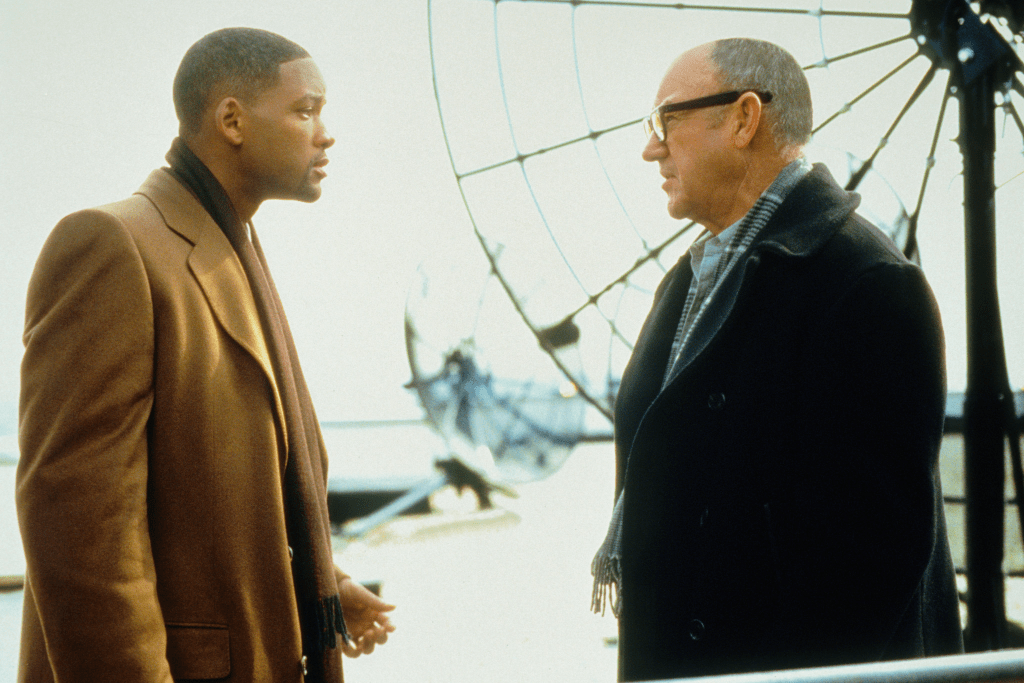
Robert had previously had an affair with Rachel, which is a bit of backstory for him and his wife’s story. Robert still keeps Rachel close, and hides this from his wife. He says it’s purely for work related business, but during some scenes, you as the viewer become privy to the fact that Robert still has in the back of his mind that something is still there.
This film is a rollercoaster from start to finish. It shows you as the viewer how if you get entangled in the wrong web in your day to day existence that certain people, and even the government of the country you live in and love, will use any means necessary to save face and make you the bad guy. Robert is by all accounts an innocent man. He did not fully understand what he was involved in until ¾ of the way into the film. He had no idea why the government was after him the way they were. Yet he still faced the consequences for being involved at all.
The only thing I have any sort of issue with in this film is the shootout scene at the very end of the movie. It was absurdly cheesy and badly edited. Despite this one bad scene, I will not be lowering my rating at all. This film puts you as the viewer straight into feeling everything that Robert feels as an innocent man, who is guilty until proven otherwise. The anxiety and thrill I felt watching this is something I haven’t felt for a film I’ve reviewed for this blog, outside of The French Connection (1971) which is funny to say since that also features Gene Hackman in a great role in it.
The entire sequence of surveillance and the use of satellite footage, tracking, and the communication between the government employees to follow Robert’s every move was great. The tension I felt for his character as he was trying to be elusive, despite every street, every building, every room having a camera in it, or a satellite above was uncomfortable. And in the last 30 years since this film was released, things have only gotten worse for the average citizen tenfold. I am one who believes that the government has overstepped their boundaries in terms of tracking the everyday citizen; and that the average person is just out here trying to exist, not conspire against the government. Robert is just a good lawyer, and a family man. He did not deserve the hand he was dealt in this film. But the fact that Enemy of the State makes it feel like this could happen to anyone, on any given day, truly gave me more anxiety than I would have liked. Especially in the modern political landscape we exist in.
As I said previously, I think this is a film that anyone and everyone should watch; It’s eye opening in a very creepy 1984-esque way. The acting is superb, the story is extremely well done, the dialogue is great, and even hilarious at some points. I only have good things to say about this one.
-4 mallards/5
-Seann

Unbroken (2014) is the directorial debut of Angelina Jolie. It’s also based on a best-selling book by Laura Hillenbrand, which is itself based on a true story. I’m not a fan of Angelina’s (though I wouldn’t say I dislike her, either), I haven’t read the book, and also I tend to not enjoy things based on true events because I feel like they rarely do justice to the humanity present in the events themselves. This is kind of a perfect storm of all three, but nevertheless I approached this film with the intent of liking it, as I do all the films I review on this blog.
Just looking at the runtime (two and a quarter hours) made me weary. Knowing that this was essentially a fictionalized version of events that befell a real person, I was concerned that we were going to have a full birth to death recounting of his life, which tends to make movies really boring and overdone. The beginning didn’t really engender much hope in me either, as we have the typical tactic of starting in the middle and then having a flashback to the protagonist’s youth. I realize this is a bit of a catch-22 that I’ve put filmmakers into: if you start at the beginning of the person’s life, I’ll criticize you for that. If you start in the middle and have a flashback to their youth WHAM you get hit for that, too. And if you start at the end of their life (like on their deathbed) then that’s probably the worst of all and BAM you’re docked at least an entire mallard for that. How can they win? Perhaps by not playing at all – don’t make fictionalized accounts of real people’s lives. Documentaries are immune from my ire for these storytelling conventions. Make one of those.
Personal predilections aside (hard as that may be), this one was actually pretty enjoyable. There were some aspects I didn’t like and I feel weren’t done particularly well, and we’ll get to those, but let’s talk about why this movie was good. First of all, it looks great. The set designs and costumes and makeup are appropriate to the time in which the events take place (that would be WWII and before), and they really help to immerse the viewer into the action of the movie. The color palette is quite subdued, which isn’t unusual for what is essentially a war movie – a lot of grey, rustic greens, and dusty browns. The design team did a great job of capturing the emotions of the WWII era through the mise-en-scene.

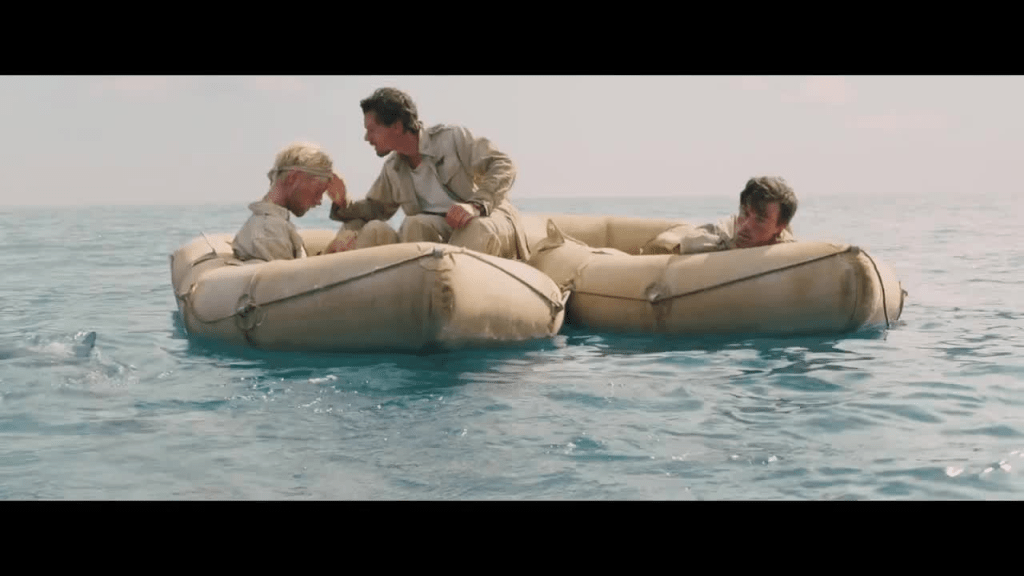
Additionally, there are some unique shots and cool film making techniques at play here. Of specific (or should I say s-pacific HAHA) note are the scenes where the three guys are adrift at sea in the raft. It’s very easy to do these scenes poorly, and this is actually a rather long section of the movie, taking up about a quarter of the overall run time. Somehow they managed to keep it entertaining despite having the same physical environment for 30+ minutes. The lighting in this section is especially well done, and when they are “rescued” there is a cool moment where the shadow of the ship descends on them in a contrast to the unvarying and cruel permanence of the sun. Similar praise can be given to the short sections of the protagonist’s youth, in which he discovers his love of running and eventually becomes an Olympian.
Additional positive aspects include the pacing. Those long scenes in the open ocean help highlight the fact that they were floating for 47 days, and they really feel like a slog during the movie, but in an interesting way. I’ve touched on my criticism of the storytelling, in which the order of events we see on the screen is poor, but the events themselves are nicely structured independent of the overall larger structure of the movie. Nothing feels too quick, and nothing seems to drag on longer than it should. The one exception to this is the ending, which incorporates images of the real-life guy and videos of him. This is entirely unnecessary, as this is, again, not a documentary, but a fictionalized version of his life.
The biggest downfall of this movie is, unfortunately, the script. The dialogue is very stock and unnatural, and at times cheesy enough to pull the viewer out of the immersion. The purpose of this movie is, really, to be inspirational. You as the viewer are supposed to be filled with not only the American spirit of resilience (this is a WWII movie, remember), but a feeling that you can overcome any obstacle by living vicariously through the life of this incredible person. With that in mind, lines like “a moment of pain is worth a lifetime of glory” become astoundingly and head-shakingly schlocky and ham-fisted. That is a real line that a character says to our protagonist. Have you ever had someone in your life talk to you like that? If so, they were putting on an act, or they were in some other way joshing you.
A few other things I didn’t appreciate were the focus on our main character when he becomes a prisoner of war, as well as the not so subtle and yet somehow inconsistent religious themes. We see a few scenes in which he is interacting with the other prisoners, but they mostly serve the role of background set pieces, as opposed to individuals of their own. Obviously they can’t flesh out the characters in any meaningful way due to the constraints of the film (and nor should they), but at least some small interactions with them in the prison compound would make the experience seem more universal as opposed to the events happening only to this one guy. The religious aspect is really only three scenes – there’s a slight moment in his youth where we see him at church (not paying attention), and then when they’re on the lifeboat asking God to save them, and at the end when he lifts the plank of wood above his head and his shadow gives the appearance of a cross. These are so infrequent and the message is so inconsistent that one wonders if it would be better to just leave them out completely, as they contribute very little to the overall themes of the movie.
Unbroken (2014) has an IMDB rating of 7.2 out of 10, a Rotten Tomatoes tomatometer score of 53%, and a Letterboxd score of 3.6 out of 5. I think these scores are in line with my own thoughts, maybe slightly higher. I went back and forth on whether to give this movie a 3 or a 3.5, but I think it’s executed well enough in terms of cinematography and set design to prop it up to a 3.5
-3.5 mallards/5
-Maxwell


Leave a comment