
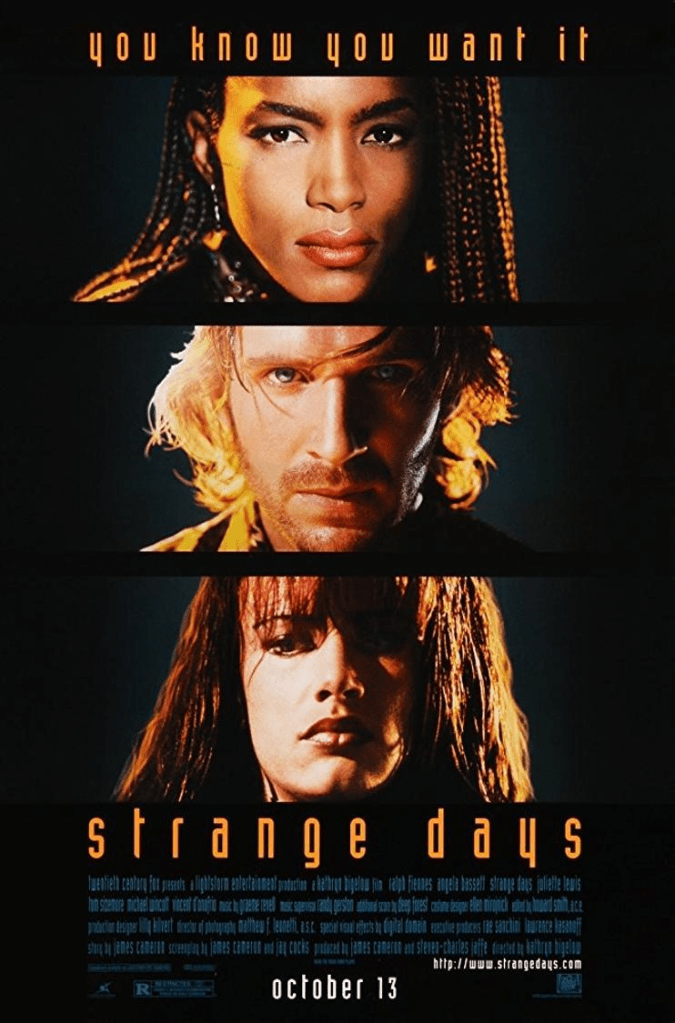
For the third week of June, I drafted a movie called Strange Days (1995) that I had never heard of previously. Upon reading the synopsis, and watching it, I truly feel that this would be a movie my dad would have “enjoyed” and said his infamous phrase “it has some redeeming qualities” about. So the fact that I was completely unfamiliar with it was surprising to me. This is a movie I had a lot of thoughts about, overall I didn’t think it was terrible by any means. But I also didn’t think it was great by any means. As I have said in previous reviews, I have referenced Dune (2021) as being a bad movie. The fact that they made it into no less than three parts and each part was boring (to me) and bad (to me) has upset me in the past. For Strange Days, I wish that this movie was a two parter.
The beginning of Strange Days was honestly a slog to get through. Lots of world building, characterization, and not much happening. The second half of this movie, so much is happening and being thrown at the viewer that I really wish this was a two parter. It wasn’t until 40+ minutes into Strange Days that I was really on the edge of my seat watching it. Up until then, I was wondering what the point of this movie was, and where it would go. After that point, I was wishing that it was giving me more. I do enjoy a fast paced movie that starts and just goes-goes-goes until the credits roll. One of my favorite examples of this is a much older film, The Lavender Hill Mob (1951). That is a film that starts and just goes for its entire and tight 88 minute run time. One of my favorites to be honest. Strange Days has a run time of 145 minutes, and feels off balance for the first half versus the second half. It makes for awkward story telling. I will delve into this later, but for now I will talk about the very good and interesting world building that this movie offers.
Strange Days, while made in 1995, takes place in 1999, on New Year’s Eve. The world is in turmoil, there is civil unrest, gas prices are up (over $3 a gallon!, which is hilarious as a viewer in 2026, given the recent War with Iran and current gas prices the average citizen is facing). The story revolves around government overreach, abuse of its citizens, and the use of this immersive VR-Esque technology that was developed by the government, but is now heavily used on the black market. The main character is a dealer for this technology, and operates in the “seedy” parts of town for it. However, he gets a “clip” (what they call the VR videos that people tap into to feel and “live” the experiences of others) where someone has raped and murdered someone. It turns out that the person who made this “clip” is an LA cop. Classic fucking cop behavior.
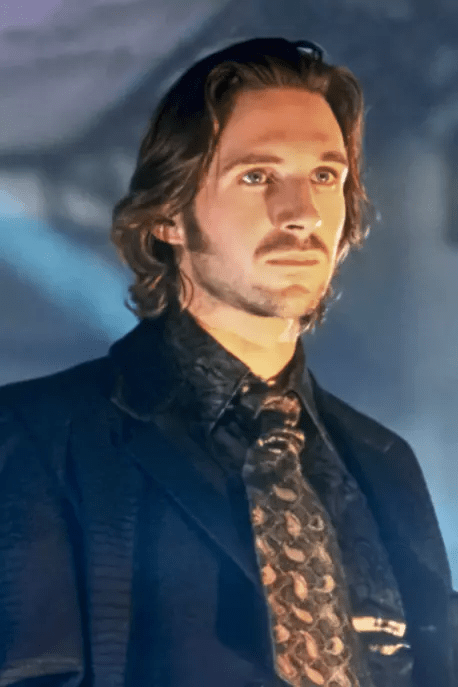
I’m going to go off a branch here in my review, and talk about the cast for a paragraph or two. The main character, Lenny Nero (Ralph Fiennes) is great. He is immersed in his role, and as the viewer, you believe his character’s motives and actions. I was really into his character’s motivations and actions the entire time. His friend, Lornette ‘Mace’ Mason (Angela Bassett) I felt like was over acting every scene she was in. I didn’t disagree with her character’s motives by any means, but her acting was so over the top the entire movie, it kind of rubbed me the wrong way. She was putting way too much into the role, and it almost became unbeleivable.
The sustenance in this movie waxes and wanes. As I said earlier, it starts off very slow with its world building and story telling, in an almost agonizing way. For the first forty minutes of the movie, I was constantly wondering where this movie would go and why it mattered. Not to say that it wasn’t interesting in its own right, but it felt like it was taking forever to make its point. Then out of nowhere, it felt like too much was happening at once. It was hard for the viewer to follow.
The story could have been much more interesting and well done if the balance between the first and second acts was better, or if, as I mentioned earlier, the movie was actually two movies. I wish in the first half, that I had less time in the world of this movie, and in the second half, that I had more time in the world of the movie. The overarching story and world building for Strange Days is interesting and intriguing, I do think this is a movie worth experiencing for yourself at the end of the day, but I do believe the way that it unfolds is rather slow and can leave you as the viewer feeling put out.
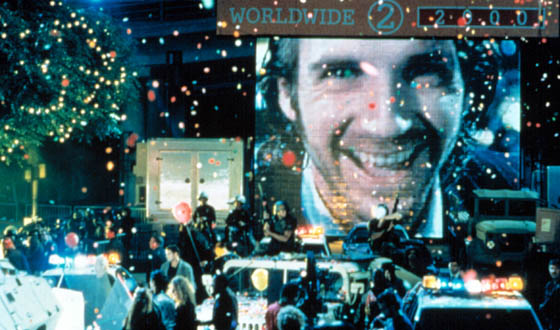
I also think that the end of this movie (spoiler warning) happens too quickly, and that the cut to credits is more unsatisfying than satisfying. Sure, the story wraps up, a lot has happened, and the main characters feel satisfied, in some regards. But to the viewer, it seems as if the writers needed the story to finish up, and have a neat little bow wrapped on it to enact the cut to credits, and it leaves you wishing there was more.
All in all, I think for the time this movie was made, 1995, it is an interesting take on 1999 into Y2K happening. As with Enemy of the State (1998) which was a good predictor of the world we exist in in 2026, Strange Days is an interesting look into the near-future of 1999, on the cusp of the new year and new millennium. For someone who was alive (albeit 10 years old) when Y2K occurred, and has some semblance of knowledge of the state of the world during that era, this movie is a good exaggeration of those times. Overall, I would recommend this movie to anyone who is into movies, whether or not you were alive during that time. It paints an interesting picture of the extremes of existence under a capitalist regime, and the suffering of the common man, despite those examples being exaggerated to the tenth degree.
-2.5 mallards/ 5
-Seann
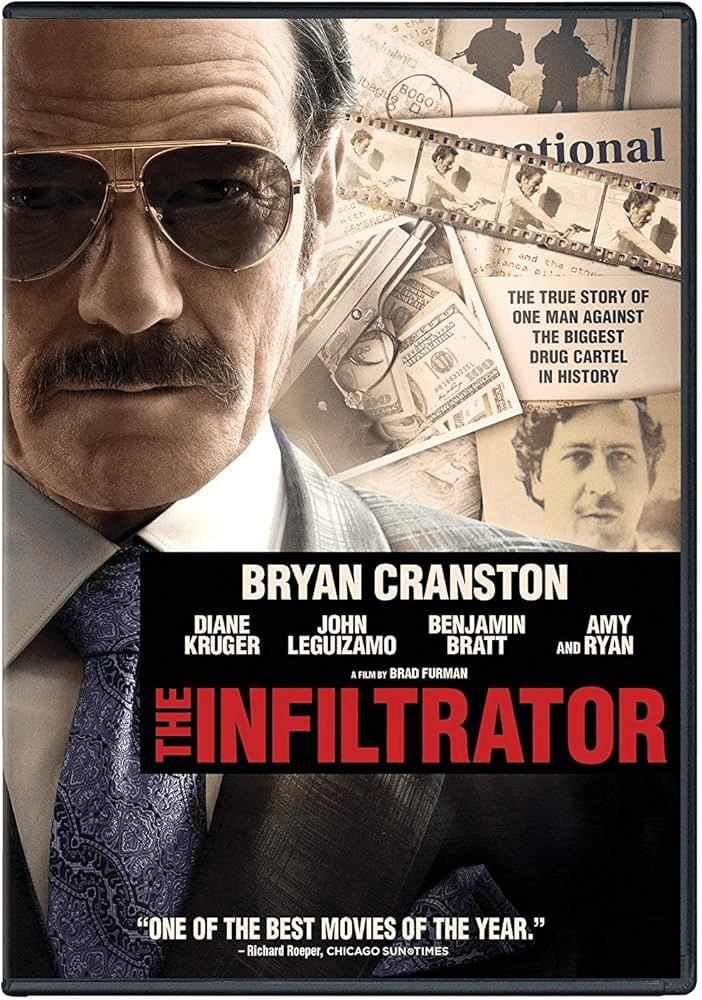
Yes, that’s right, for the third week in a row I’ve managed to somehow end up watching a movie that claims to be a biography or in some way based on a true story. The Infiltrator (2016) boasts some pretty big names in its cast, such as Bryan Cranston (fresh off of the conclusion of the show Breaking Bad, in which he played a man in over his head in a world of drug kingpins and danger), who plays a man in over his head in a world of drug kingpins and danger. This time, however, instead of being the one making the drugs and avoiding the police, Cranston IS the police, and he’s going after one of the biggest names in the biz – Pablo Escobar.
Of the three movies I’ve watch for the blog this month, again all of which have been biographical, this one does the best at opening. I complained previously about opening with a flashback, or opening with the conclusion, or opening in the middle. I think the way this film does it is appropriate – the first shots are just right into the action. There’s no jumping around in time or anything, there’s no melodramatic “my life is so sad and here’s why” or anything – it just starts. There are a few other things this movie does better than the two others, but a lot of that might just be personal preference. I didn’t exist in the early 1800’s when Mary Shelley did and I didn’t exist in the 1940’s (or go to war) like the dude from Unbroken (2014). I’m also not involved in any sort of criminal underworld, so maybe this theory doesn’t hold up….
Anyway, this movie is pretty good. It’s the longest of the three, but it feels like the shortest. It’s engaging the entire time. It’s suspenseful, the characters are charismatic, the stakes are higher (much higher than the other two), the acting is way better, the script is far superior, and in some ways it looks better. It accomplished all this on a budget that was 2/3rds of Unbroken (2014). We won’t mention the budget for Mary Shelley because, well, it was very nearly an indie film. That’s not to say that this movie is perfect or anything (no 5 this week, sorry folks – maybe someday, but I doubt it) but its flaws are minimal and its successes are bombastic.
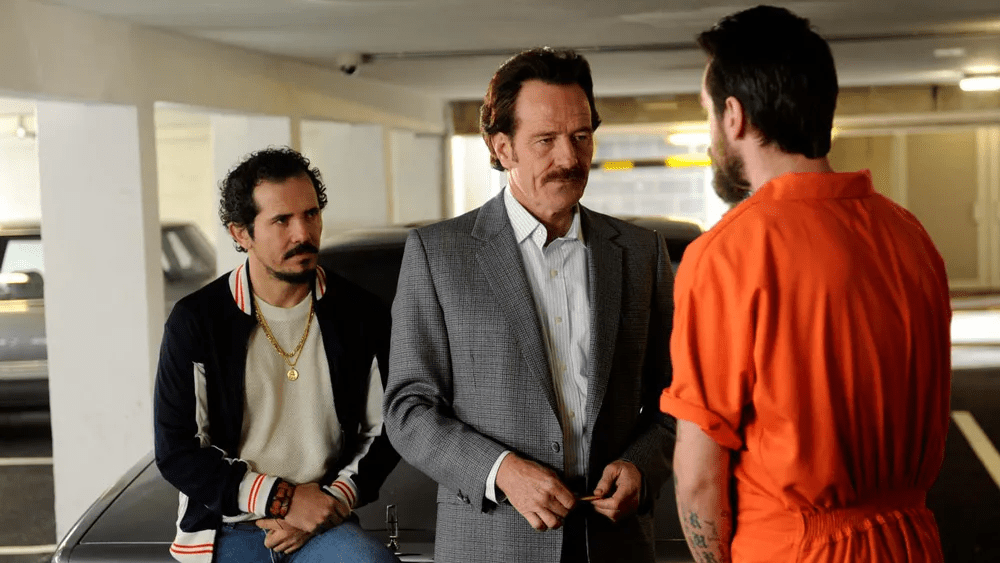
We’ll start with the successes. As mentioned previously, Mr. Cranston (the father from Malcolm in the Middle), delivers a superb performance as always. He’s on-screen for essentially the entire runtime of the movie, and in fact there’s only one scene in which I think he’s not present (when two women are talking – his fake fiancée and his real wife – but they are talking ABOUT HIM: sorry Bechdel testers). If he didn’t do well then this movie, therefore, would have fallen completely flat. It doesn’t fall flat, therefore he did a good job. Other performances of note are John Leguizamo, who plays his buddy, and the lovely Diane Kruger, who plays his undercover fiancée.
The way this film is shot is perhaps the biggest boon to its success, as is often the case in thrillers, of which this is kind of. Basically, like with all undercover cop movies, the drama comes from whether the good guy (or who the filmmaker has decided to portray as the good guy) will be found out or not. Of course there are moments where they make you think “oh, this is it, he said something strange, they’re going to find him out!” or some character that’s unaware of the situation says something incriminating, etc. I didn’t say this film was groundbreaking or anything, just that it was well-made.
Often the camera is very close to the actor’s face. We get very few wide angle or panoramic shots, and that’s for good reason. The camera is mirroring the emotional content of the character’s interiority. Cranston is trapped in a web of deceit and lies- if he makes one small mistake, his cover will be blown, and the people with whom he’s engaged will have no quibbles about killing him. Additionally, through these close-ups, we get to see the anguished expressions, the faces of worry or concern, and the visages of relief when things go his way. As a filmic convention, this is one of the more simple and easy-to-understand ones, but it is ultimately effective.
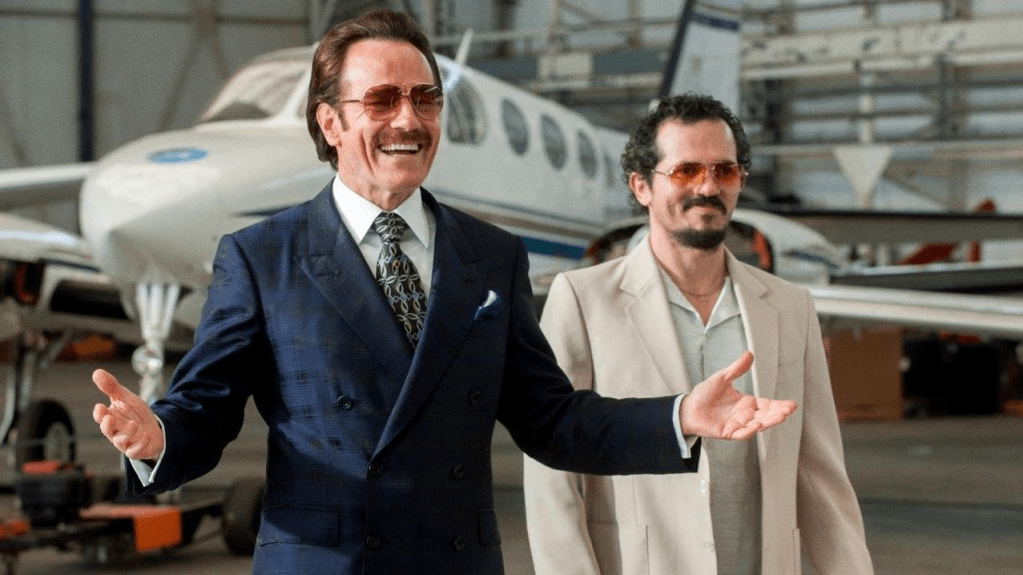
The demerits of this movie are somewhat minimal, with one exception. First, a couple of small things: the costuming is overly-formal so as to be distracting. Everyone is in a suit, and they never wear the same suit more than twice, and the jewelry is always different, and there are always different fancy vintage cars. I understand these people are wealthy beyond belief, but I think they also would likely want to keep a low-ish profile. I don’t think money launderers walk around in designer suits with gold cufflinks, coca plant rings, and wear sunglasses indoors. They probably want as little attention as possible, but I might be wrong.
The biggest mistake this movie makes, and I think this is likely because it’s based on the book that this real life guy wrote, is that the domestic life of the Cranston character is so boring and unappealing when compared to the undercover work he’s doing. Any time there was a domestic scene, or a scene in which his wife begs him to retire, it totally ruined the momentum. We (meaning I) don’t care about any of that stuff. I think the film would lose nothing (perhaps some external motivation to not have his cover blown, although there was plenty of that already) if these scenes were removed entirely. But that’s just one mallard’s opinion.
The Infiltrator (2016) has an IMDB score of 7 out of 10, a Rotten Tomatoes tomatometer score of 72%, and a Letterboxd rating of 3.2 out of 5. These scores seem slightly low to me. Reading some of the reviews online, the biggest critique is that it is “boring”, which I didn’t feel at all. I’m not sure if these reviewers’ brains have been fried due to consuming too much short-form content, but calling this movie boring or a “snoozefest”, as I’ve seen multiple times, is an admission of lack of attention as opposed to a critique of the film itself. I liked it a lot.
-4 mallards/5
-Maxwell


Leave a comment