
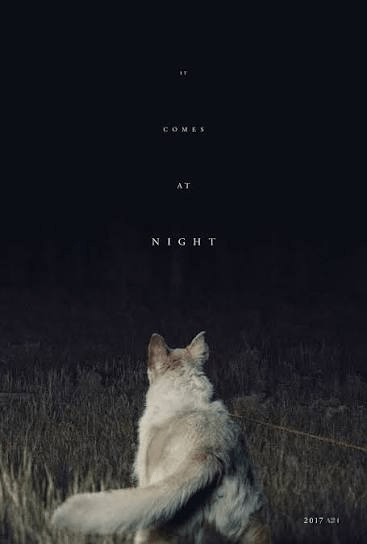
For the second week of July, Maxwell chose one of the two horror movies in the draft, so I immediately chose the other one as my pick. Maxwell is someone who doesn’t typically watch horror or enjoy that genre as a whole, while I am someone who has a love for horror and enjoys seeing them, especially in the theater. It Comes at Night (2017) is one that slipped under my radar. I had never heard of this movie, knew nothing of it before I booted up the television to give it a watch, and to be honest, I wish I still knew nothing of it. There’s a major difference between a movie that is a slow burn, and one where nothing happens (except perhaps one scene) and this falls into the latter hard.
The premise of It Comes at Night is that it is a psychological horror about a family surviving in a post-apocalyptic world. The family is the father Paul (Joel Edgerton), the mother Sarah (Carmen Ejogo), and the son Travis (Kelvin Harrison Jr.). They live in a farm house in a rural part of the south, only leaving the house when needed for supplies. The first of only three (maybe four) things that happen in this movie’s 91 minute run time is that someone tries to break into their house at night, Will (Christopher Abbott). They tie him up outside and leave him there overnight. At this point I was expecting something crazy to happen to Will, but he survives, nothing occurs to him whatsoever, and then Paul unties him and they go to rescue Will’s family, Kim (Riley Keough) his wife, and their young son Andrew (Griffin Robert Faulkner).
On the way to bringing Will’s family to live with them, their truck tire gets shot out, and they kill the two guys in the woods who shot at them. Then there is a random time skip of a few days and suddenly they’re back at the farmhouse with Will’s family.
Then we are faced with another big chunk of nothing happening, and Travis’ dog Stanley runs away into the woods barking at something. Travis chases after him, and the subtitles say CRUNCH. Then nothing happens. Then out of nowhere, Stanley is back, and inside the house, but injured to the point that Paul has to put him down.
Again, nothing happens for another 20 or so minutes of run time, then they believe that Andrew is sick. This causes a big fight where Will attacks Paul, Sarah shoots Paul, and Kim runs off with Andrew in her arms. Paul tries to shoot Kim but instead shoots Andrew, and then while Kim is screaming, Paul shoots her too.
The last thing that happens in this movie is Travis gets sick with the unexplained disease and dies, and Paul and Sarah are left sitting at the dining table alone. Then the credits roll.
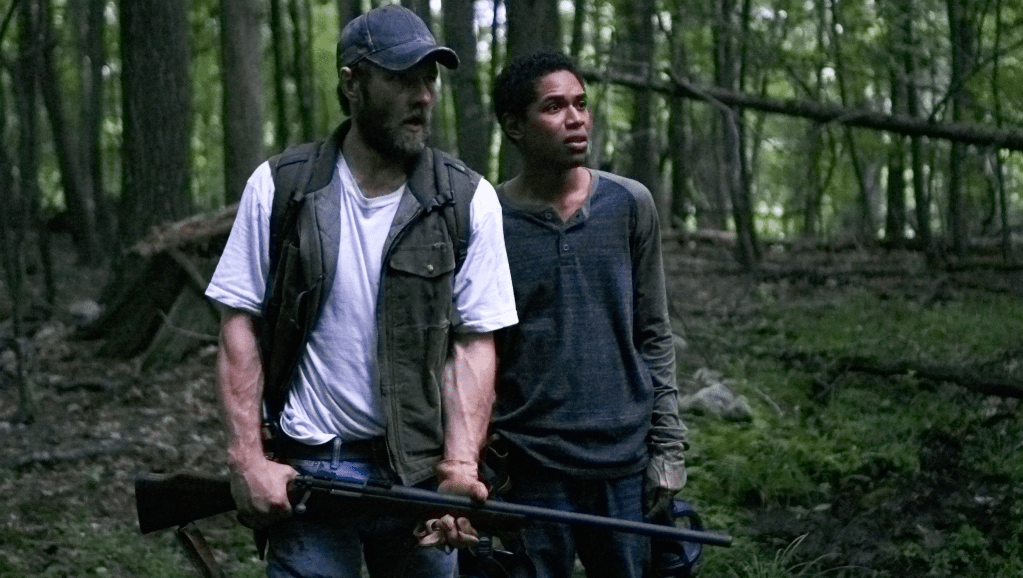
This entire movie’s plot I have just summed up for you in five paragraphs, and half of them, I would get marked down in high school English for not being full paragraphs… I kept waiting for anything to happen or be explained. It was too ambiguous. I enjoy a good movie that leaves you thinking due to not showing or telling the viewer everything to fully explain the story you are consuming. For instance, another movie I have seen recently (from the same production company) Backrooms had me thinking about the possibilities of what actually happened for probably three days after. It Comes at Night showed and told you so little of the world that the movie takes place in, doesn’t explain an ounce of anything, that I was just upset at wasting 91 minutes of my evening on it.
The only semi interesting part to the whole story was that Travis had trouble sleeping and was often sneaking around the house at night, so potentially he could have been sleep walking or in an insomnia induced state and not thinking properly in one or two scenes that occurred. But even this line of thinking falls on its face when you consider that they showed and told the viewer so little that it wouldn’t matter if this was or was not the case.
July has been a really disappointing month for me so far. I think I am going to rate this one extremely low, and again, not recommend it to anyone when the options for a good, thought provoking horror movie are so vast nowadays.
-0.5 mallards/5
-Seann
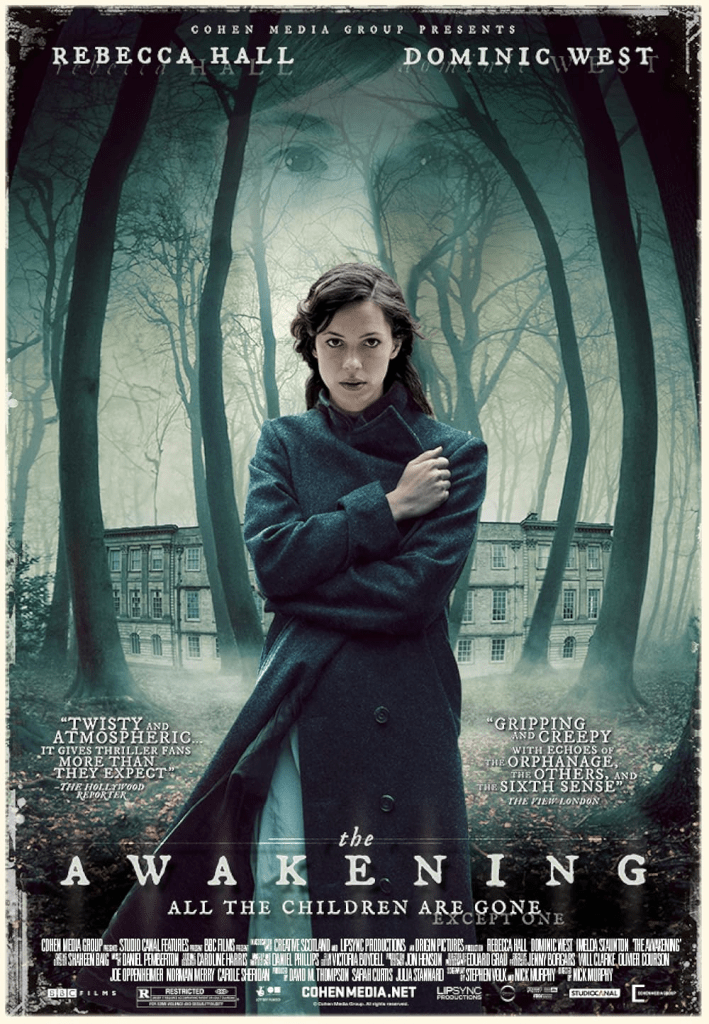
The Awakening (2011) is the first outright horror film that I will review for the channel, due in large part to the fact that I try to avoid drafting them. I honestly thought this might be a movie about Kate Chopin. Horror isn’t really my preferred genre, and although I’m very familiar with the production norms and tropes of the genre. It’s hard to say why I tend to not enjoy horror – I think what it boils down to is that the goal of most horror movies is not something with which I usually vibe. I tend to gravitate towards more thought-provoking, slow, and ‘boring’ films and genres. This isn’t to say that there are no horror movies I enjoy (the original Nosferatu (1922) for example is one of my absolute favorite films, and some recent works of note like Hereditary (2018) and The Babadook (2014) are very well done), just that the examples that are created seemingly to have as many jumpscares and as much body horror as possible don’t really do it for me. Yes, once again, I’m saying that I’m not like the other girls – the horror movies made for the masses do not appeal to me.
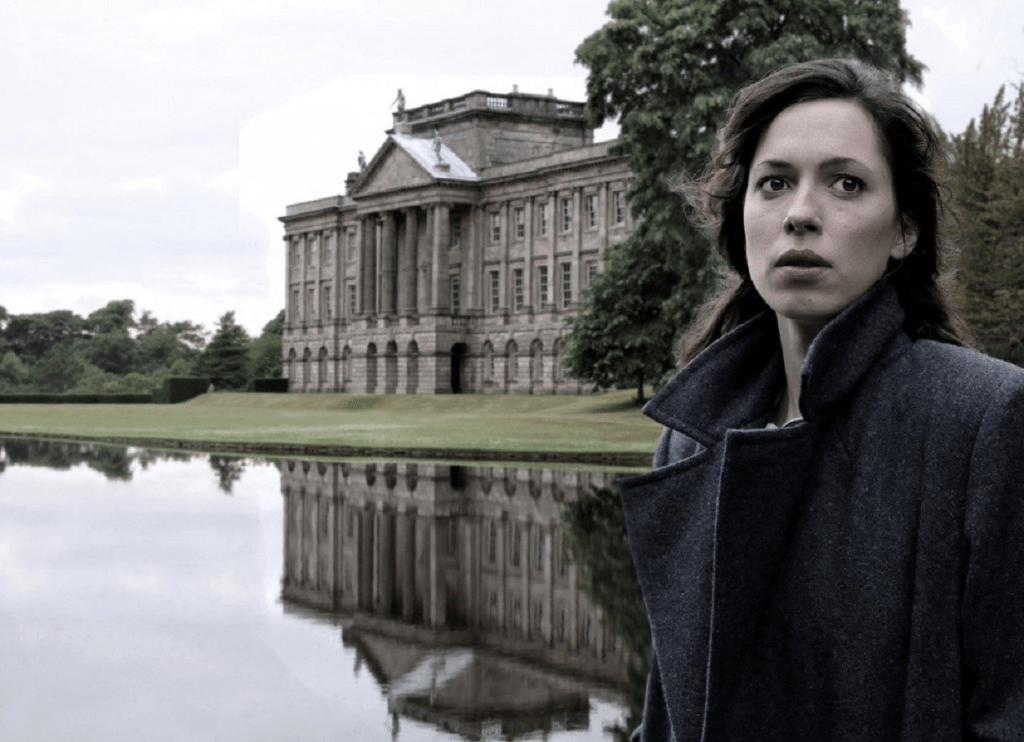
Luckily for me this film is British, and therefore slow, plodding, and difficult to understand (much like the British themselves). All joking aside, I was able to appreciate the artistic elements of this movie in a way that I can with few other movies of this genre. The setting is rather mundane – a derelict boarding school for young boys in the middle of seemingly nowhere. The building itself is classic horror movie fodder, almost as if the architect who made it said, while drawing up the plans, “oh yeah, this thing is going to be SO haunted.” Not only is the building itself right out of a trope, but there’s also a murky lake with untold horrors, and a creepy one-lane road surrounded by dense forest. Whomever did the location scouting for this movie deserves a lot of credit for its quality.
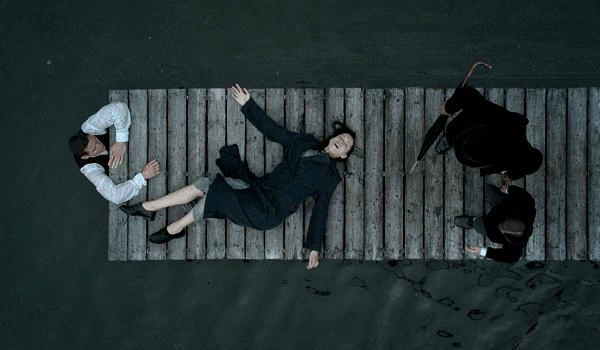
These positive aspects of the setting are further bolstered by some excellent cinematography. We get a great mix of wide establishing shots (especially when we’re outside) and close-up, claustrophobia-inducing shots (usually when something scary or spooky is about to happen). The color palette is exceptional and quintessentially British – I would say the most dominant color in the movie is the pale, overcast, gloomy gray that always seems to linger over London. As a horror movie that is set in an old building there’s obviously a lot of playful things done with the lighting. Some corridors are lit, some are lit faintly, and others are completely shrouded in darkness. The scenes in which we follow Cathcart (Rebecca Hall) while she explores the mansion/school are a bit troubling because it feels like she’s in a sort of maze of unending rooms.
Additionally, the acting is phenomenal. To be realistic, there’s only about four characters in the movie, and one of them is a kid. Despite this, we never feel like we’re bored of the characters. This movie does, unfortunately, rely on the classic drama-creating technique of withholding information from the viewer until the end (and I don’t even mean the cliché horror movie twist ending), so the dialogue will sometimes feature lines or conversations that are bewildering to us (at that moment of first viewing). Perhaps it would do an interested viewer to watch this one a second time (as I did).
Speaking of the script, and the plot of the movie as a whole, it’s really a letdown. The visual qualities of this movie really carry the entire thing, because the plot is, at the best of times, unobtrusive and a bit pedestrian, and at the worst times utterly confusing and nonsensical. If one thinks of this movie as a collection of visual scenes that are strung together loosely by a vague thread, then it becomes much better than if one thinks of it as a typical movie. There are a few jumpscares that are rather unwelcome, and are not set up particularly well, but there are other scenes that are much more unsettling. The frequently recurring dollhouse (which seems to teleport around the mansion?) is a great example of eerie horror done well through atmosphere and cinematography (what the kids would call ‘vibes’) as opposed to horror of ‘wow look at this crazy non-human thing!’ although there is a bit of that as well in this one.
Finally, the ending is also a moment of disappointment. It’s open-ended, but it gives me the feeling that the producers/writer/director didn’t know how it should end, as opposed to intentionally writing an ending that can be interpreted multiple ways. It’s like they decided they didn’t know what to do, so they would just be as vague as possible and let the viewer come to their own conclusions. The issue with this, of course, is that in an ambiguous ending there has to be conflicting evidence pointing in multiple directions – it has to actually BE open-ended. The ending here was just kind of…nothing. She might be dead, or she might be a ghost, or she might be alive, or she might be, I don’t know, an inflatable life raft on the side of a cruise ship. All of these have equal evidence from the ending (meaning none at all).
The Awakening (2011) has an IMDB score of 6.5 out of 10, a Rotten Tomatoes tomatometer score of 64%, and a Letterboxd score of 3.1 out of 5. These ratings are all right around the same ballpark, so there seems to be a general consensus about the quality of the movie. I think I honestly would have enjoyed this more without the supernatural elements, as the best parts to me were the cinematography and setting. I feel like I’m also required to dock half a point because I just don’t think the ending was satisfying. I’m not asking for everything to be wrapped up with a bow and laid out before us, but at least a small indication of the conclusion would be nice. It does look great, though.
-3 mallards/5
-Maxwell


Leave a comment