
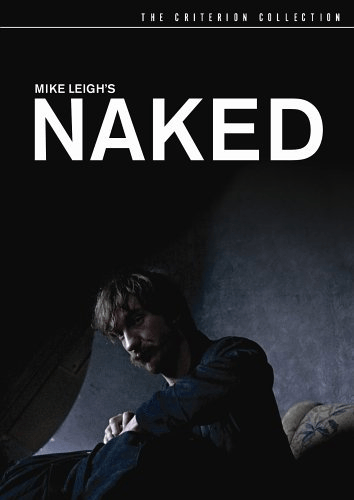
For the first week of August, I was able to choose the first selection. Once we rolled the dice, Maxwell said “Oh one of my favorite movies is here this month.” So naturally, I asked which one (I was secretly hoping his answer would be “Toy Story Toons: Small Fry (2011).”) However, the actual answer he gave was “Naked (1993).” A film I had never heard of somehow. I immediately chose it as my first week’s film. I wanted to see what Maxwell liked about it, and I didn’t want him to have an easy review right off the bat to write, obviously. And boy I am happy that I picked it.
This movie is gritty, dark, and appears to be an exercise in minimalism. Almost nothing occurs in Naked, yet I am left sitting as the credits roll pondering the film, the world we live in, my own journey throughout life. Even a couple days after having viewed it, I find myself thinking back on this film.
I think to truly understand this film, you have to know a bit about history, and about the director. Naked was created in the post-Thatcher UK, at the start of the 90s, a decade with many technology and life changes seen and felt around the world. Naked is a movie about apocalyptic morality at its core. About the individual who has been left in the shadows by society as a whole. It’s funny that I watched this the week after I reviewed Joker (2019) when both films are very similar concepts at the start, but Naked handles it in a much more mature and gnarly way.
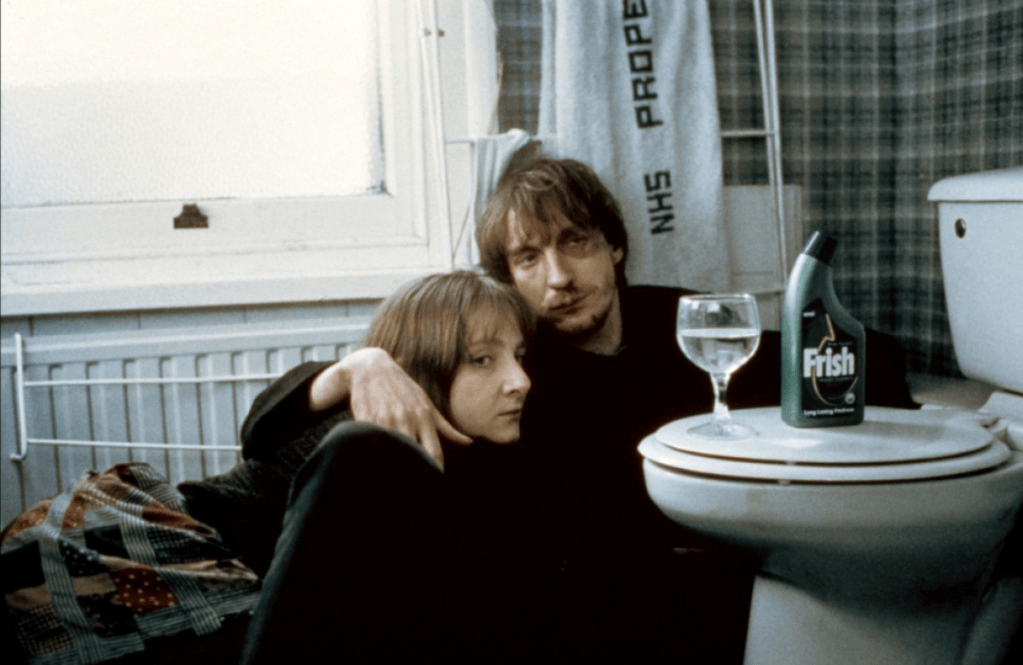
One of the beautiful things about this not very beautiful film is that the entire story takes place over the course of maybe three days. It feels like you as the viewer are getting to experience a day in the life of the main character, Johnny (David Thewlis). And it is not a good life. The film’s premise is that Johnny has left Manchester due to a violent act he committed with a woman (the presence of consent or not being ambiguous), and he finds a former partner of his in London, Louise (Lesley Sharp). He shows up unexpectedly at her doorstep, while she’s out at work.
One of the things I found depressing and interesting at the same time was Louise’s roommate, Sophie (Katrin Cartlidge) being an almost mirror of Johnny. We learn very little about her character throughout the course of the film, but the parallels of her and Johnny’s life and existence (to a degree) was an interesting character choice. Of course, because Johnny is a nihilistic opportunist, he ends up sleeping with Sophie. And she is just as emotionally stunted and broken as Johnny, but her way of handling this causes her to fall for him, rather than wanting to discard him once she gets her way with him.
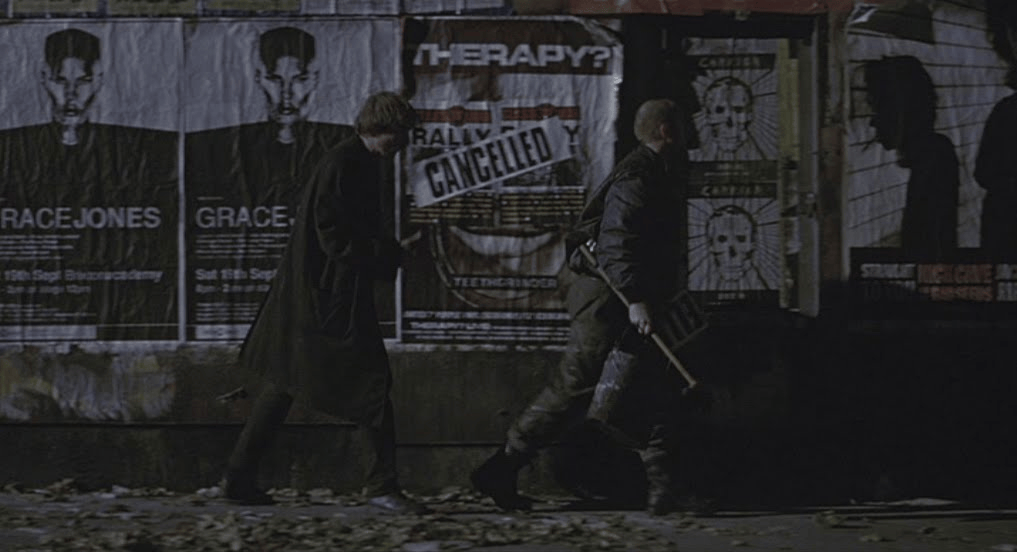
The setting of Naked is near perfect. Watching Johnny traverse London, especially the scenes that take place over a night out with nowhere to go are darkly beautiful. The lighting is absolutely perfect in this film. The framing of the scenes, the use of shadows, color, light, just everything. For how ugly the story of this film is, the way it is conveyed to the audience is immaculate.
There was one thing that I didn’t know I knew about from this movie, and it’s a scene where Johnny and Louise are chatting over some morning tea in Louise’s house. Johnny is already awake, bundled in a blanket, reading a book. Louise comes downstairs into the room, and asks such a simple question. “Were you bored?” To which Johnny replies with an oft quoted monologue, that honestly really hits home for me: “Was I bored? No, I wasn’t fuckin’ bored. I’m never bored. That’s the trouble with everybody – you’re all so bored. You’ve had nature explained to you and you’re bored with it, you’ve had the living body explained to you and you’re bored with it, you’ve had the universe explained to you and you’re bored with it, so now you want cheap thrills and, like, plenty of them, and it doesn’t matter how tawdry or vacuous they are as long as it’s new and it flashes and fuckin’ bleeps in forty fuckin’ different colors. So whatever else you can say about me, I’m not fuckin’ bored.”
I have the entire world at my fingertips, via my cell phone, my television, my PC, my collection of books (only half of which I’ve read), through my friends, etc etc. Yet, I do still find myself sitting on my sofa, being bored. Perhaps it’s the illusion of choice, the lack of time to properly dive in to these things, it could be a thousand different reasons. But I do still find myself ‘bored’ at least a few times a week. This scene was, to me, the best scene in the entire film.
There is also a third roommate, Sandra (Claire Skinner) who is uptight, rigid, and a workaholic. She is only seen dressed in white clothing, a direct opposite to Johnny’s costuming, which is black skinny jeans, a black shirt, and a black overcoat with black boots. Despite these obvious differences, we encounter a character who we have been getting scenes of here and there throughout the film, of another character, Jeremy (Greg Cruttwell), who is also a womanizing, abusive asshole (much like Johnny). But the main difference between Johnny and Jeremy is the status of life they grew up in. Johnny grew up poor with a mother who hated him. Jeremy clearly either came from money, or came into money. But at the end of the day, they are both dicks. And somehow, for some reason, Sandra used to date Jeremy. Not much is explored here, but it shows the audience how life is full of sadistic people, who come at you from all angles and all walks of life.
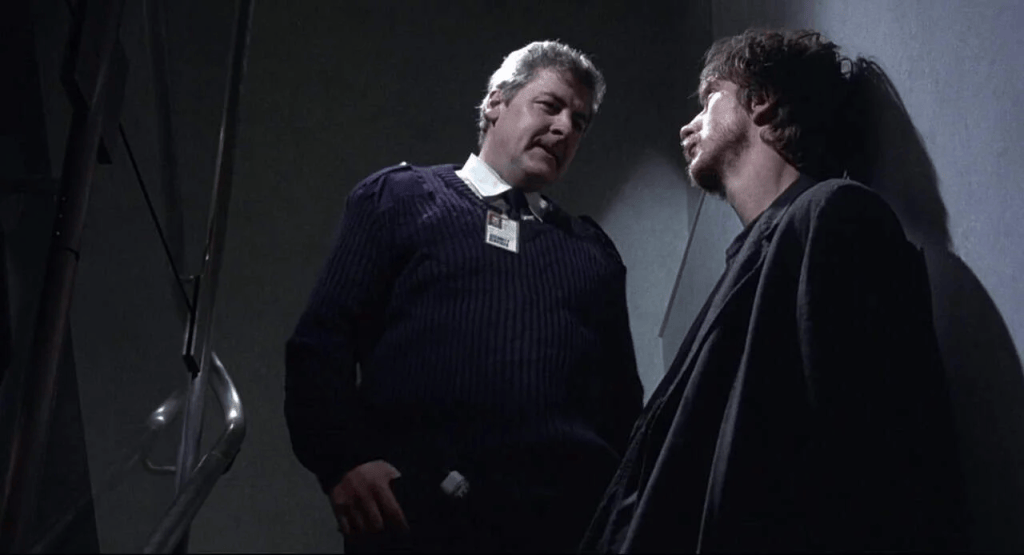
One thing I did and didn’t like (I still can’t make up my mind) is the end of this movie. Louise is bored of her job and her life in London, she misses her hometown of Manchester, and wants to return home. She still has feelings for Johnny, it seems like she believes she can ‘fix’ him. It gets to the point that she leaves to go quit her job, and is ready to pack up and take Johnny with her back to Manchester to live happily ever after. Once she’s out of the house however, Johnny gets up, and leaves. He hobbles down the street away from her London house, off into the city once again, and the credits play.
This ending is perfect for a film of this nature, and I can appreciate that. But part of me still wanted Johnny to try and be happy. Life circumstances, and his mental state prevent him from even trying. I am left feeling a strange empathy, and emptiness inside. As I said at the start of my review, this is a movie that has left me pondering it for days after viewing. And I don’t think I’ll stop anytime soon. Would I recommend this film to people? Yes, if you’re the right kind of person to view such a work. It is ugly, dark, and a difficult watch. But also a great watch.
-4 mallards /5
-Seann
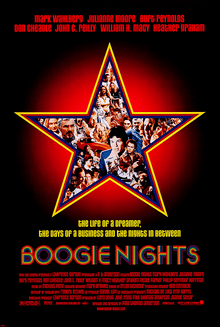
Boogie Nights (1997) is the second film by much acclaimed and celebrated director Paul Thomas Anderson (PTA henceforth). This is kind of a cult classic film with a pretty devoted fan group, however, somehow I’d never seen it before. I enjoy many of PTA’s films, especially There Will Be Blood (2007), and Inherent Vice (2014). Clearly we have some similarities in that we both like Thomas Pynchon. Both of us also wear glasses, but that’s less important. How I’d never seen this movie all the way through is unclear to me. I know people have referenced it around me before and I somehow understood the references, but I suppose some aspects of this film are just sort of in the zeitgeist.
The first thing that stood out to me about this movie is that it’s really really long. The runtime is over two and one-half hours, rivaling that even of The Odyssey (2026) and approaching The Lord of the Rings: The Two Towers (2002). I had a bit of an idea of what this movie was about, so I was a bit puzzled at how it could be so long. As it turns out, about thirty minutes of it could have been removed, and the movie would benefit from this (but I’ll get to that).
The plot of the film is relatively straightforward – it follows the rise, fall (and rise again?) of a youth who enters the world of adult entertainment in the 1970’s and early 1980’s. Fairly predictably, he gets wrapped up in a world of excess: drugs, cars, women, and crime. I actually found some of the side characters’ stories more compelling than Eddie’s (Dirk Diggler, as he’s known). The (friend of the channel) Don Cheadle character, Buck Swope, seemed to me to be the most human in what was otherwise a bit of a Flanderized cast of cartoonish characters. His story is one of a struggle with his identity, both during and after his time in the industry, which is handled in a mature and humanistic way, despite him often being shown as the comedic relief when he appears.
Other characters along the way, such as Reed Rothchild (played by friend of the channel John C. Reilly) and Jack Horner (played by Burt Reynolds), also function as comedic relief while also pulling the plot, such as it is, along. While I’m insinuating that there’s not much of a story here to go off of, I didn’t really find myself bored or uninterested in the characters while the film was rolling, until the end.
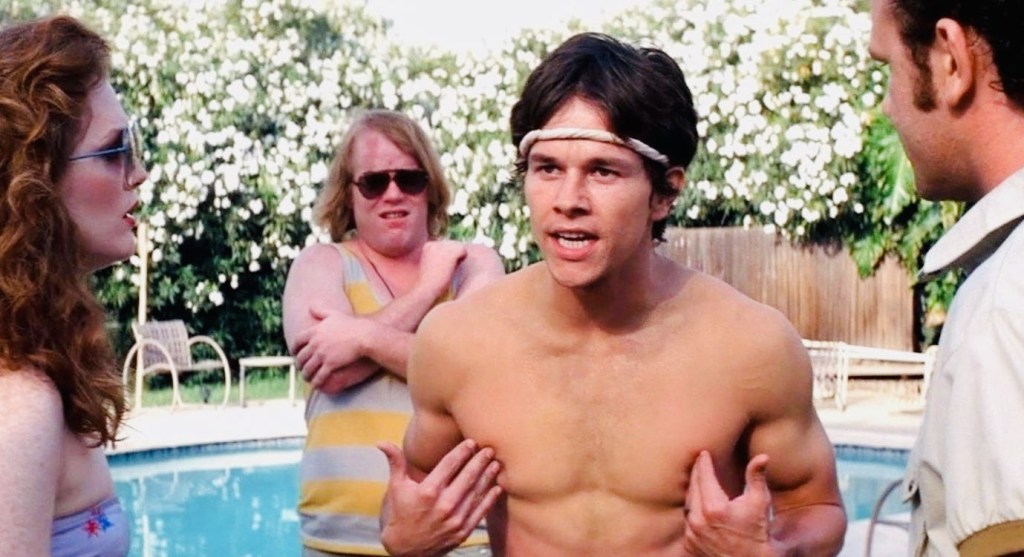
I think the reason why this film was so engaging was because of PTA’s expert use of camera movement and angles. Even though this was only his second film, we can see glimpses of what would become something of a signature style for PTA that would show up more often and consistently in his later films, specifically the aforementioned There Will Be Blood (2007). As you can probably surmise, there’s many moments in this film in which we’re shown the interior of Jack Horner, the adult film director’s, home. There’s wild parties, drug use, people lounging in and around the pool, and more. The camera moves through all of these scenes fluidly, making the viewer feel as though they’re there in the house witnessing all of this. In what would usually result in a very chaotic and disordered mess of an act, through appropriate and dare I say masterful dolly usage, PTA manages to hold our attention on each of the characters almost simultaneously, allowing us to listen in to their own conversations that further their subplots and set up future actions in the movie.
In addition to the expert camerawork and movement, there’s some really witty and slick dialogue throughout this film. The characters are consistent, even those that appear infrequently, and the conversations they have are pretty entertaining throughout. It’s not particularly realistic, because most people in real life are a bit boring (my self included), but it does make for a good show. I also enjoyed the aesthetic of the sets, specifically the house I mentioned earlier, and the way the characters dress. It really does give a 1978 California vibe to the whole thing, in my estimation. Keep in mind that I wasn’t there or anything, and PTA wasn’t either (he was born in 1970), but it’s a great version of an idealized past.
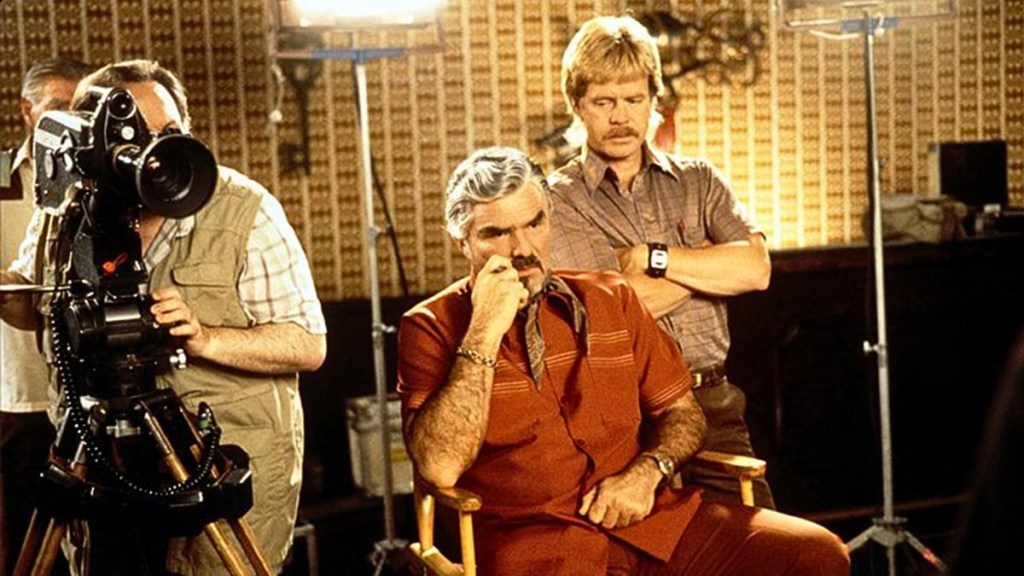
Unfortunately, as I mentioned already, this movie overstays its welcome by about thirty minutes. Right around the time Dirk entered his failed music career arc I could feel myself starting to lose interest. There’s no real ‘redemption’ arc as we would call it today, and the film ends entirely on kind of a cliffhanger. The only issue is that a cliffhanger is supposed to leave the audience in suspense, while I really didn’t care about knowing what would happen after the credits roll. Any good will I had towards Dirk was extinguished rather quickly, and the violence done to him by a group of random frat guys (?) didn’t instill in me any sort of pity for him. It’s clear we’re meant to be rooting for Eddie (Dirk’s real name) in the beginning, and the film does a good job of establishing that in the first act, but by the end it’s rather unclear about how the film wants us to feel about him. Personally, I didn’t come back around to liking him, which made the ending, which I think PTA intended to be a bit triumphant, feel rather meaningless. I think the film should have ended as soon as he got fired from the video set, with maybe a short-ish wrap-up for the other characters.
Boogie Nights (1997) has a score of 7.9 out of 10 on IMDB, a Rotten Tomatoes tomatometer rating of 91%, and a Letterboxd score of 4.2 out of 5. It seems this film is almost universally enjoyed heavily, if not loved, and it’s not hard to see why. When you consider as well that PTA was only 27 at the time he wrote/directed this, and it was only his second full-length film (the star-studded cast also makes it hard to believe), we can forgive him for some of the errors I mentioned above. Good movie.
-4 mallards/5
-Maxwell


Leave a comment