
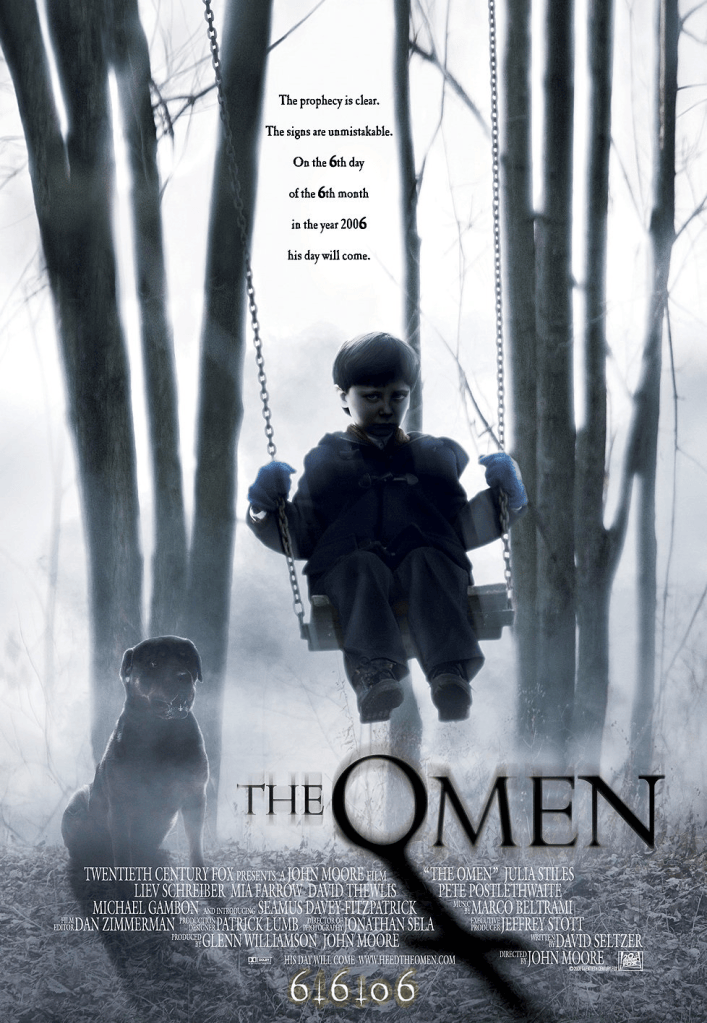
For the last week of October, I chose The Omen (2006) as my movie. I was not super thrilled with this pick, but I also did not want to watch The Hunger Games: Mockingjay – Part 1, as I think that series had a huge fall off and felt stale by that point. The Omen is a movie that I had seen in theaters as a teenager, and at that point, I had already seen the original as well. My stance on it before watching it for the blog, and still after having watched it this week, is that I don’t know why they felt the need to remake it at all. The original still stands up 50 years later, even better than the remake from 20 years ago.
I will start off by saying that there were a few things I liked from a film making perspective that the remake did. The setting and the atmosphere were done very well, in a way that really helped set the tone that the movie was trying to convey. There is a scene where Robert Thorn (Liev Schrieber), the dad, is meeting with Father Brennan (Pete Postlethwaite), a priest who is trying to warn him of Damien. They meet under a bridge in a heavy downpour. The mood in this scene is dark, ominous, the conversation they have is cryptic and spooky. After their conversation ends, when Father Brennan is running through the rain, the architecture of the town he’s in is old, gothic, beautiful, but eerie. There are a few other scenes that are set up like this that really help set the mood of the movie.
But on the other hand, there are some scenes/uses of the camera that are just laugh-out-loud bad. For instance, when Robert is on the bed and a dog starts growling at him, there is a weird shot where the camera is slowly panning out, but then zooms back in for a second, and then back out. Trying to be a tight shot, keeping the focus on Robert while the dog is growling off screen. I don’t know why but it was so cheesy and badly done that I was taken out of the movie for a second and could only laugh at my television.
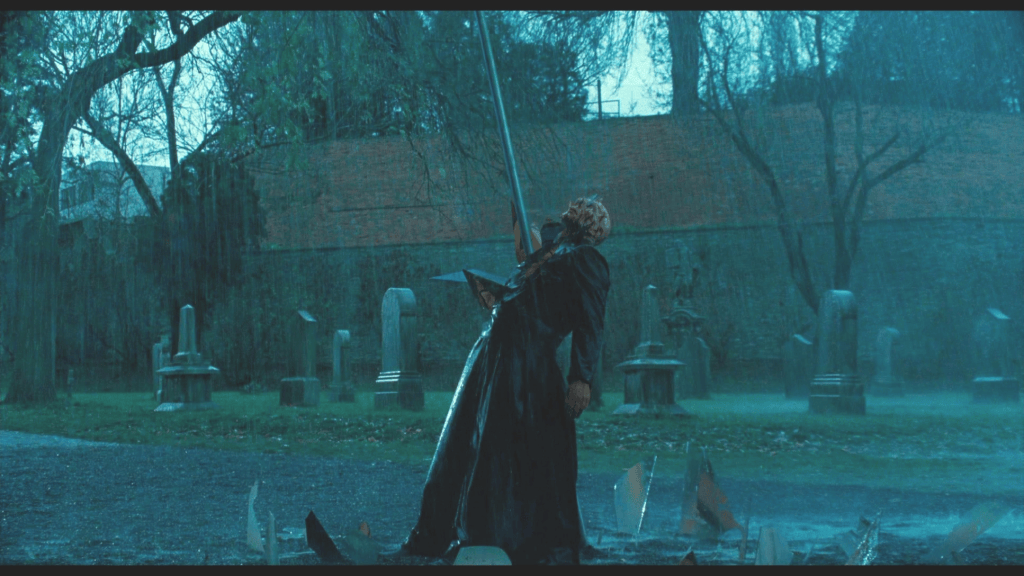
The use of CGI in this movie is also really cheesy, and obviously a product of its time. After Father Brennan and Robert finish their conversation under the bridge, Father Brennan is running to a nearby church. The front door is locked however, and lightning from the storm strikes a spire on the church. The spire falling and piercing Father Brennan through his heart is also a laugh-out-loud moment. Who thought that looked at all acceptable during production?
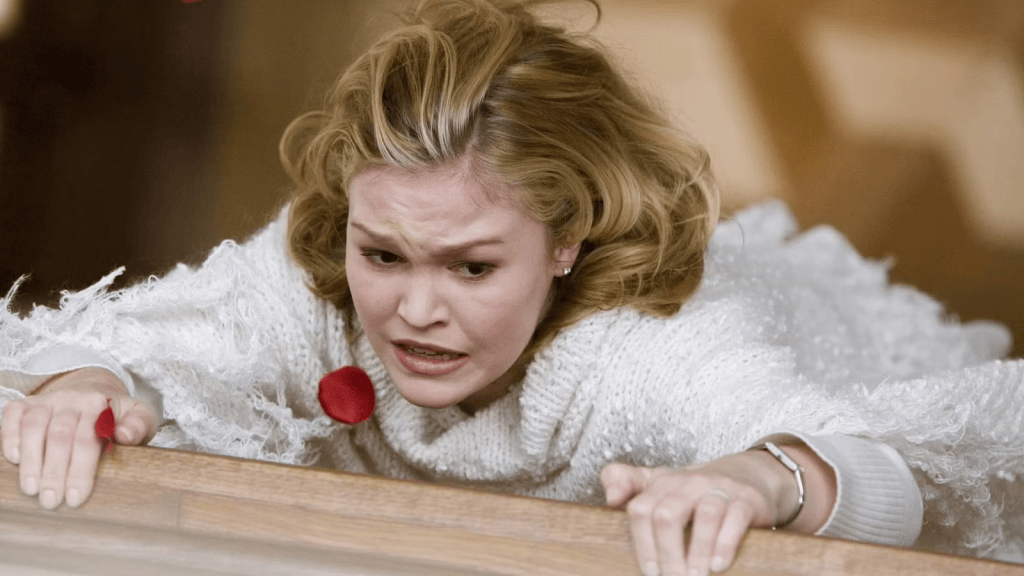
Some of the scenes are just downright cheesy and over the top, like when Katherine Thorn (Julia Stiles) is watering her plants by standing on a chair over the top floor railing, and Damien (Seamus Davey-Fitzpatrick) is riding his scooter through the house. The length of this scene is obscene. We all know what’s coming, but the way they drag it out was just painful. The main change here is a scooter instead of a tricycle. But that’s it. The other really cheesy and awful scene is near the end, when the Nanny, Mrs. Baylock (Mia Farrow), is already under the influence of Damien and after Robert returns home, fully accepting that Damien is in fact the antichrist. Robert steals Damien out of his bed, and is leaving to bring him to a church to kill him. Mrs Baylock grabs a polo mallet, smashes his windshield, and then as he’s speeding out the driveway towards the gate, she stands in front of his car with the mallet above her head. He hits her and she does a full 360 flip in the air over the car and dies. The CGI used here is once again laughably horrendous.
The best character in the whole movie is Keith Jennings (friend of the blog, David Thewlis), and of course by being the best character in a horror movie, by being smart, and correct about the way things should be handled, he gets offed in a very comical way. He plays a photographer/reporter that is always around taking photos of events that Robert Thorn is at (since Robert is a politician). David plays the role perfectly, at first he’s a mysterious and ominous side character, but in the second and third acts he becomes a pivotal piece of trying to stop Damien and help out Robert.
Like everything else in this movie that goes wrong, Robert is too damn stubborn of a character. If he had just listened to the priest in the hospital, or his wife at any point, or not tried to shun Keith’s advice, the outcome would have been very different for everyone. Instead, Robert gets what’s coming to him.
I fully understand this is a remake, and as I mentioned earlier in my review, I am left wondering why anyone felt the need to remake it. Most of the deaths in this version are one for one, the same deaths as the original movie. They do almost nothing new or interesting in this version. And it feels like the entire final act, after Robert returns home from Rome, accepts that Damien is the antichrist, and is finally willing to do something about it, is rushed just so they can get to the end of the movie. I’m not complaining, considering that I don’t think this is a particularly good watch in any way. But the pacing feels completely off in this part of the movie.
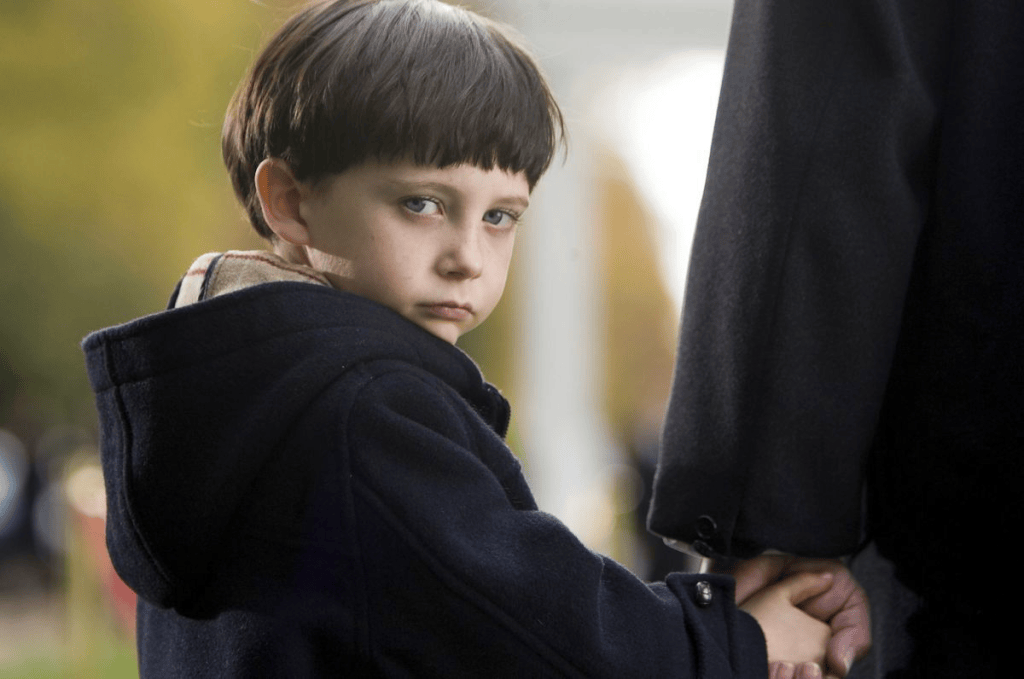
Despite overall not thinking this is a great, or even a good movie, I still think ultimately that it’s fine. I mean, I would recommend any day of the week to just watch the original, considering this is practically a carbon copy of it. But this movie is fine as far as being a movie goes…
2 mallards /5
-Seann
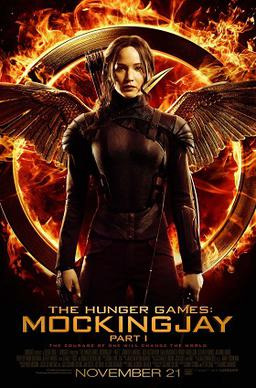
The Hunger Games: Mockingjay – Part 1 (2014), in addition to having an absurdly long name, is the third film in the much-acclaimed Hunger Games movie franchise, based on the popular book series of the same name, written by Suzanne Collins. These books, and subsequent movies, were released and became popular right around the time I was in late high school/early college. I was slightly older than the target demographic, and also I thought I was really smart, so I only read mature literature and watched art films at this point. In addition, I was essentially allergic to anything that was popular at the time – I was what is known as a ‘free-thinker’, meaning I didn’t like what everybody else liked, largelybecause everybody else liked it.
This is the first time I’ve had to review a sequel on the blog, and with that brings some unique challenges and questions. I asked a few people familiar with the series if watching this movie without the prior films would lead to a purer review (in which the quality of this production could be considered without the consideration of the others) or a poorer review (in which I would be so gosh darn confused about the story that writing about the production would be difficult). The answer was unanimous – to give this one a fair shake, I had to watch the whole series.
So, that’s what I did. Starting with The Hunger Games (2012), then The Hunger Games: Catching Fire (2013), and finally (unless I decide to watch the final installment) The Hunger Games: Mockingjay – Part 1 (2014). As you can probably tell by the quick succession in which these films came out, Lionsgate was really trying to capture the popularity and wring out all it could from this moment in time. Calling this series ‘popular’ would be an understatement. The first movie made about $700million on a budget of less than $80million, meaning it made almost ten times what it cost to produce. The second movie got a bump to its budget, costing around $130million, but brought in around $870million. The third cost around $125million and made about $766million.
We’ve established that these movies are wildly popular (and continue to be – in fact, there’s a new one coming out in less than a month). But does the adage from my original paragraph hold true? Are these popular simply because they’re popular, and people are a hive mind of consumerism and conformity, or are they popular because they have artistic merit and are well-made? These are two extremes obviously, and as always the truth is somewhere in the middle.

With that lengthy and rambling set up out of the way, I can talk about the actual movie. Out of the gate, I’ll let you know that in my opinion this movie is easily the worst of the first three. I’m not alone in thinking this – it has lower ratings across the board than both of the first two installments. Taking a peek at the metascores of the last film, The Hunger Games: Mockingjay – Part 2 (2014), it seems that it recaptures the glory of the first two. There are a couple reasons that this movie is so much worse than the first two, and I’ll expand on three of them in the paragraphs to follow.
The first and biggest reason is that this movie is exceptionally boring (relative to the previous ones) despite representing a huge shift in tone. The focus of the series switches from the eponymous hunger games themselves to a more complex political lens. Katniss becomes the face of a revolution, begrudgingly, which means less fighting and action and drama, and more talking, philosophy, and subterfuge. It’s just not as appealing, and I personally don’t find the world of Panem particularly interesting. It’s a world pretty much like our own, and there’s very little allegory or metaphor that the audience has to connect to the world in which they live – it just seems like maybe an alternate universe that is not that different from our own.
The second reason is that this movie is just not particularly well-shot. There’s a sequence, when the denizens of district 13 are fleeing further underground, that is borderline unwatchable. It’s simultaneously too dark and too bright. There are strobe lights that make it impossible to tell what’s going on, and are actually painful. I guess the intention here is to make the viewer feel as if they were in that chaotic environment while it was going on? Even if that’s the case, it was too disorienting, and it put me off for the next couple scenes because at that point I was honestly a bit mad at the director. How much the average viewer cares about things like this is something that can be debated (somewhere other than here).
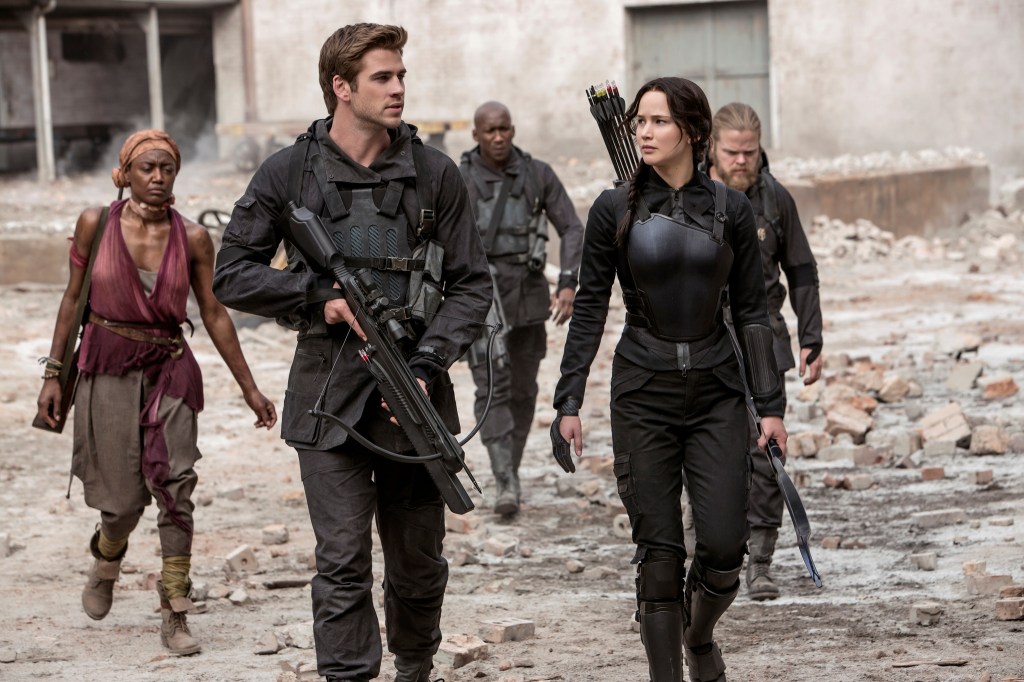
The third reason is that I don’t find the romantic relationship between Katniss and Peeta to be very engaging or interesting at all, and I feel even less interested in her relationship with Gale. I’m sure they’re fleshed out more in the books (as I’m sure all the other aspects of the world are), but in the movies their relationships just feel pretty hollow and unimportant. I guess going through traumatic experiences has bonded them, but that doesn’t exactly make me care about it in any more meaningful way.
With these three gripes out of the way, I guess it’s important for me to clarify that I actually did enjoy this movie. I enjoy the concept of the world as a whole, and I find the world of Panem to be interesting, if not entirely distinct from our own. I like the characters, and that they have clear motivations. I like Phillip Seymour-Hoffman (RIP) and the Woody Harrelson character. I’ll probably end up watching the fourth movie at some point, just to see how everything concludes. I can see how this was wildly popular, at the front-end of the ‘young adult dystopian’ craze that has died down since COVID.
The Hunger Games: Mockingjay – Part 1 (2014) has a score of 6.6 out of 10 on IMDB, a Rotten Tomatoes tomatometer score of 70%, and a Letterboxd rating of 3.4 out of 5. It’s pretty good, but not great, and certainly the worst of the series.
3 mallards/5
-Maxwell


Leave a Reply