
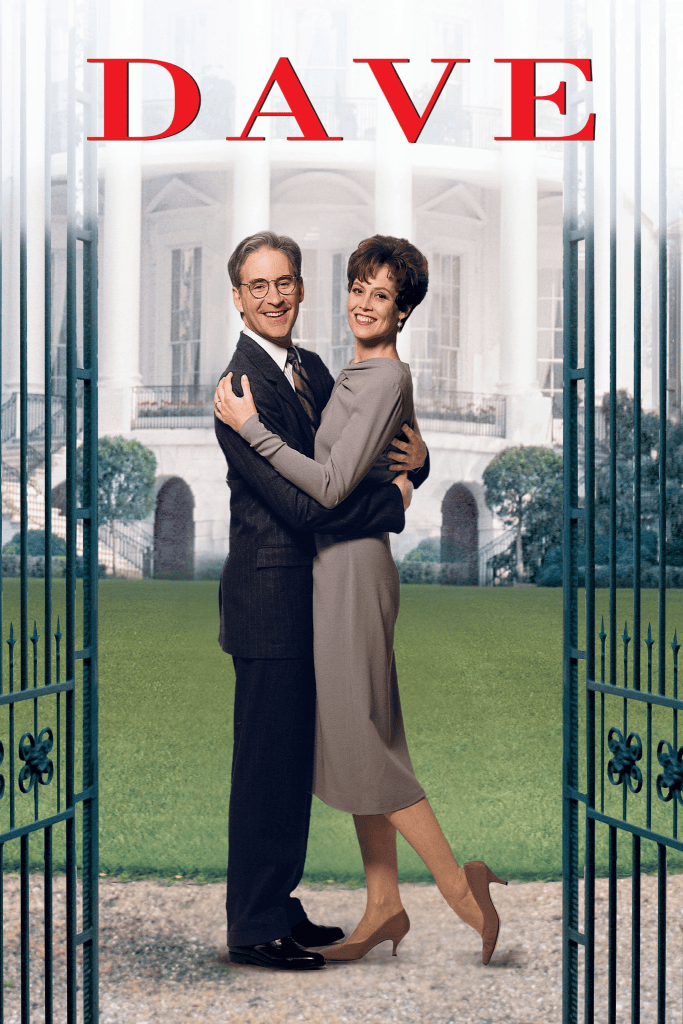
For the second week of November, I picked what I consider to be a 90s classic, Dave (1993). A cute and heartwarming light comedy. It’s not over the top like Adam Sandler or Jim Carrey comedies of that same era. The plot of Dave is a bit over the top, but they handle it in a toned down way. Dave is about the title character, Dave Kovic (Kevin Kline) being a stand-in double for the President of the United States when the actual President, Bill Mitchell, has a stroke and goes into a coma.
Dave is a man of the people. He runs a small hiring agency that helps disenfranchised people find work, and truly believes in the self respect and self worth one can gain from not feeling like an outsider of society. On the contrary, President Bill Mitchell is secretly having affairs with his staffers, and his relationship with The First Lady, his wife, Ellen Mitchell (Sigourney Weaver). Dave is obviously barely aware of all of these moving pieces, but comes in to be a double for the Presidency in his own way.
This movie is by definition a comedy, and there are some funny parts, but it is also intensely sincere in the way the character of Dave acts and is. I think a better way to classify Dave would be to call it a light comedy, or a feel good movie.
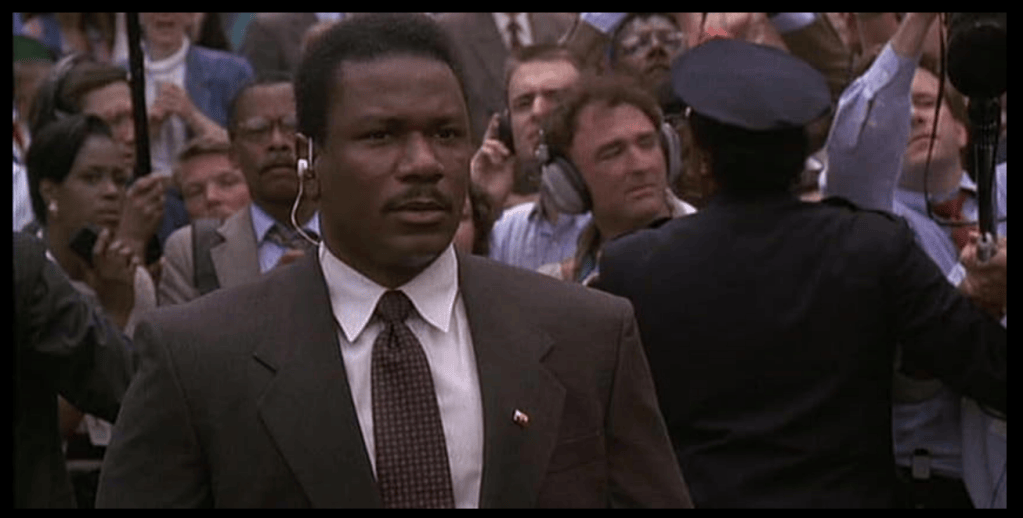
My personal favorite character in this movie is Duane Stevenson (Ving Rhames), a secret service agent that personally works for the President. Ving Rhames is wonderful in his role. Early on in the movie, when Dave and Duane first meet, Dave asks “You would take a bullet for the President?” to which Duane replies stating that yes he would. At the end of the movie, when they’re saying their goodbyes, Duane says “Dave… I would have taken a bullet for you.” I didn’t actually cry at this part, but I could feel my heart warming up. It’s delivered in such a genuine way, and you can tell that that’s the effect that Dave has on those around him. He actually played the role of the President, not only did he pretend to be the President, but he actually enacted laws and policies and worked towards the betterment of the American People. This is really where the movie goes “over the top” as I mentioned above. They have to toe the line of not letting anyone outside the inner circle know that Dave is an imposter, and part of this ends up with Dave actually doing the job.
The “Villain” in Dave is Bob Alexander (Frank Langella), Bill Mitchell’s Chief of Staff. Bob is trying to weasel his way to the Vice Presidency, and subsequently, after President Bill Mitchell’s stroke, the Presidency. His plan for making this happen is to frame the Vice President Nance (Bill Kingsley) for a savings and loans fraud, (a fraud scheme that he himself was involved in as well as President Bill Mitchell, nonetheless).
This plan is foiled by Alan Reed (Kevin Dunn), who is the White House Communications Director. He works closely with Bob Alexander, but quickly begins to see the evil in his plan. Alan is another underrated character in this movie. Kevin Dunn plays this role perfectly. During an argument with Bob Alexander, when Alan finally tells him off, it feels rewarding. The character development is rewarding here. Alan wasn’t fully on board with Bob’s plan in the first place, but he did set out to help him initially.
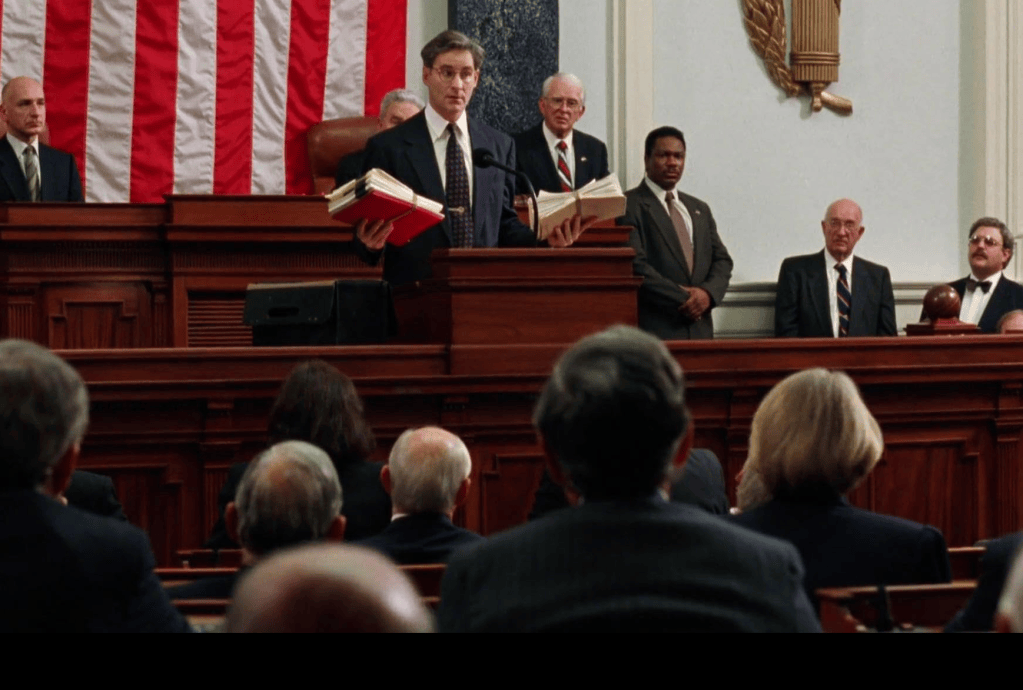
In the end, Dave and Alan must host a press conference to address the accusations of the savings and loan fraud that Bob has publicly stated was solely Vice President Nance’s doing. Dave and Alan have gathered all of the evidence pointing to the fact that not only was this largely Bob’s doing, but also that Bill Mitchell (whom Dave is impersonating) were the culprits of the scheme. At the end of the press conference, Dave fakes having another stroke, and is rushed out in an ambulance.
The real President Bill Mitchell never woke up, and Vice President Nance took over the Presidency, and Dave returned to his small town. But Dave saw the light of what holding a position in an office can do for the greater good, so he is running for a local council seat.
There are two great moments that occur in the same scene, first, I forgot that this is the movie where the phrase “We’re walking, we’re walking.” is from. This happens when we see a tour group that is touring the White House for a few brief moments. The other great line of dialogue that is in this scene is when the tour guide says “Whatever changes from one administration to the next, the White House always maintains its dignity.” I genuinely laughed out loud at this line, and then got a little sad. This may have been a true statement in the year 1993, but as we know now, in the year 2026, this is so far removed from the truth it’s depressing.
Dave (1993) is a really light and easy watch. Overall, it’s enjoyable. It’s not a deep thinker, and to be honest, it’s not particularly funny in the traditional way you’d expect a comedy to be. But it is a good film for what it is.
All things considered, Dave (1993) was a pretty successful movie for its time. With a budget of $28,000,000, it made back $63,000,000 during its box office run. On IMDb, it has a score of 6.9. On Rotten Tomatoes, it has a critic score of 95%, and an audience score of 72%. Its Letterboxd rating is 3.5. I think that the critic score on the Tomatometer is too high. This is a good movie, but not a great one. 90%+ is insanely high in my opinion. However, I still definitely recommend this movie to anyone. It’s entirely worth your time.
3.5 mallards/5
-Seann
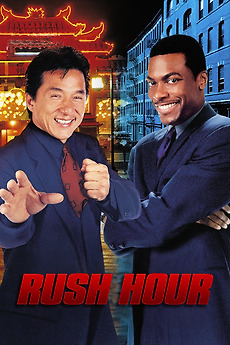
Rush Hour (1998) is a classic buddy cop comedy film that utilizes a similar comedic setup to a film that I’ve reviewed previously, Twins (1988). Although Jackie Chan and Chris Tucker are not supposed to be twins, they are still paired together through a series of odd circumstances and come from totally opposite worlds. They must work together to solve a crime, but they have different motivations for doing so. Chan wants to save the kidnapped girl because she’s a friend of his, and Tucker wants to solve the crime simply to earn the respect of the police department, which finds him a nuisance but for some reason refuses to hire him.
The duo spend more time hanging out and trying to one-up each other than they do trying to solve the crime, which sort of takes a backseat to the interpersonal dynamic between the two leads. Chan and Tucker have great chemistry on screen. Chan is a happy-go-lucky, yet serious and disciplined martial artist (as he is in real life, as well) while Tucker is a rather flamboyant and cocksure youngster, looking for his big break in the LAPD. There are some supporting characters, the most important of which is known as ‘Johnson’, played by Elizabeth Pena. Can the two come together and overcome their differences to find the kidnapped girl? Can they become friends along the way?
The answer is, of course, yes. I feel like this movie is in the cultural zeitgeist such that nothing I can say in this review will come as a surprise or shock to anyone reading this. There are quite a few iconic lines in this movie, the most obvious of which is when Tucker asks, animatedly, “do you understand the words that are coming out of my mouth?!’ In addition to famous quips and comments, there are famous scenes as well, such as when Chan struggles to fight off would-be assailants while also trying to save precious ancient pottery from China. He manages to do all of this successfully only to, of course, have the pottery shattered by a stray bullet at the last possible moment.
What’s truly excellent about this movie is that it doesn’t take itself too seriously and it doesn’t try to be anything that it’s not. They didn’t need to reinvent the wheel for this one – just get two pretty likeable guys into roles in which their differences can be pointed out, slap a pretty boiler-plate yet interesting plot onto the script, get 90 minutes worth of usable footage, including a few big explosions and some humorous yet impressive fight choreography, and watch the money roll in. And the money DID in fact roll in. The budget for this movie was $35million and it made about $245million. That’s not too shabby.
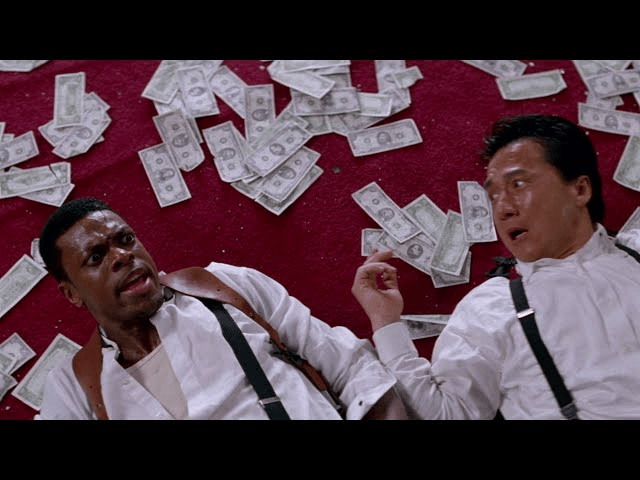
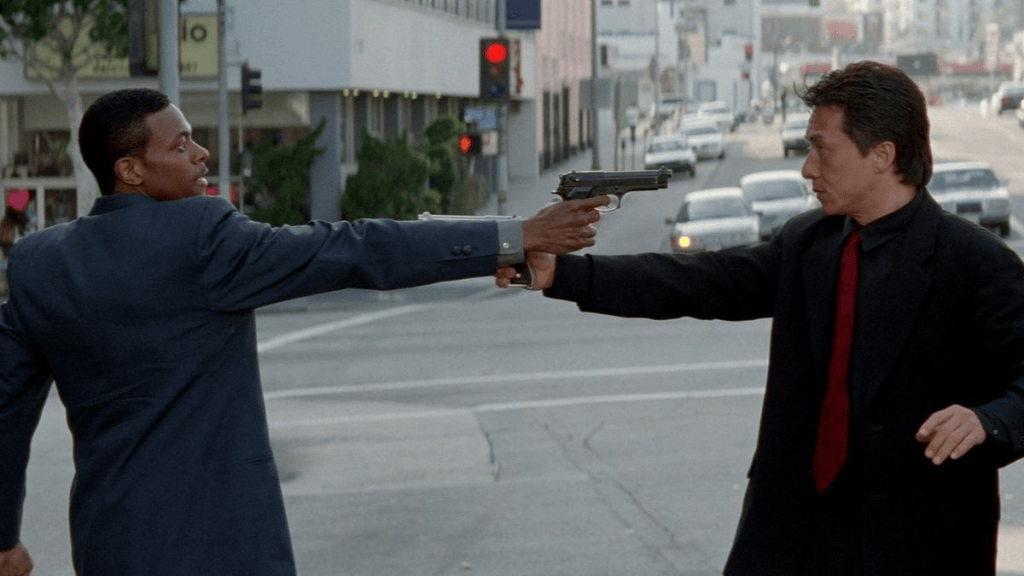
One of the things I was watching for in this movie was whether the humor seemed dated or otherwise uncouth for the current feelings in the year 2026. The only example of this was when Chan says the N-word twice, which I don’t think would fly in a movie these days. Other than that the humor was still largely effective. I particularly liked when the kidnapper calls, Tucker picks up the phone, and when the kidnapper asks for his name, Tucker replies ‘what’s your name?? You’re the one who called me!” Another favorite moment is when Tucker is in pursuit of the escaping Chan, and he commandeers, as a function of his role as an FBI agent, a motorcycle from a citizen by pointing his (unnecessarily) large handgun at him, and then smacks him to the ground.
Another great aspect of this movie is how many small things seem to recur over and over again. There’s a scene where the two practice wrestling a pistol out of one another’s hands, which comes up later on in the movie for each individual as well. Additionally, the two bond over Tucker’s apparently newfound love of Chinese cuisine (he likes ‘camel hump’, which is left open-ended as to whether Chan is having a bit of fun at his expense or if this is a xenophobic joke from the scriptwriters). The iconic song “War” by Edwin Starr recurs during a scene partway through that shows the pair bonding, and then again at the conclusion of the movie. It’s small examples like this that make this just a very solid movie all around, with very few things to nitpick. If anything, I would say that the stakes of this movie aren’t really that high, and there’s a bit off suspension of disbelief required to accept the basic premise, but it’s easy enough to do these things.
I’d like to point out, finally, that the final scene takes place in a pretty impressive building, which is the Los Angeles Convention Center. This is a pretty ingenious place to have a large gunfight, because it’s essentially a large open atrium that features a series of intersecting and cross-cutting suspension lines descending from the ceiling. The parties on the floor off the building have to improvise their cover behind things like signs, displays, and movable bars set-up for the convention, while the parties higher up can use the labyrinth of descending columns as cover and obstacles through which to deke their assailants. It’s a decently well thought out touch in a movie that could have been much less thoughtfully made.
Rush Hour (1998) has a score of 7.1 out of 10 on IMDB, a Rotten Tomatoes tomatometer score of 64%, and a Letterboxd rating of 3.7 out of 5. This isn’t the most artistic movie out there, but it’s undeniably funny and rather timeless. I like the chemistry of Chan and Tucker. I can’t help but think that the scores of this movie are brought down by the glut of sequels that were not as successful. Based on this movie and this movie alone, I’m inclined to give this a bit higher of a rating than the sites listed above.
4 mallards/5
-Maxwell


Leave a Reply